Spanish electrical terms in English: a glossary for Seville, Spain
Spanish electrical terms in English, explained in plain language: diferencial, magnetotérmico, ICP, boletín, potencia contratada, toma de tierra or wallbox, with the British and American equivalent, the rule behind each one and when you need an electrician.
Spanish electrical terms in English, without the jargon
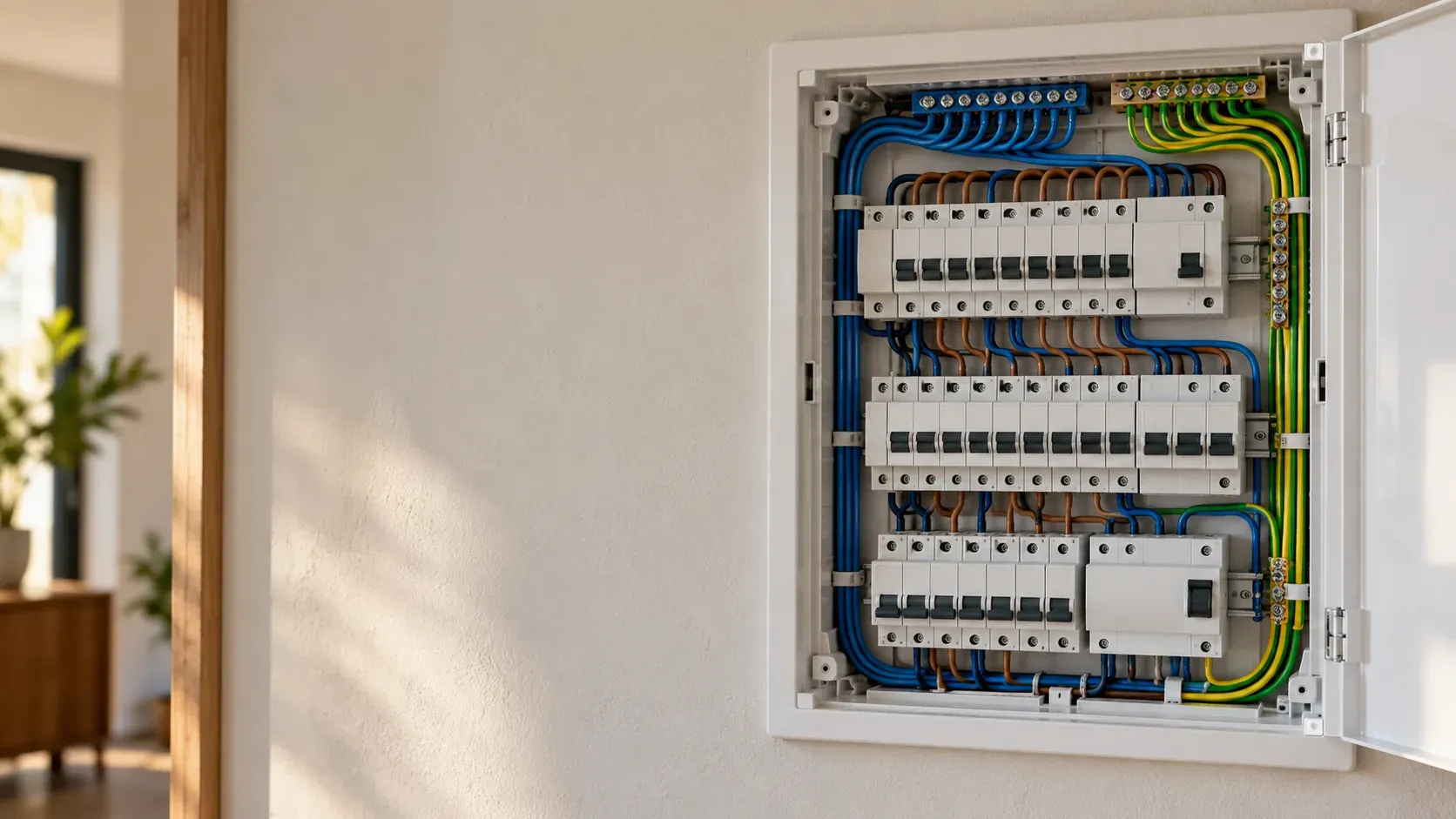
When a Spanish electrician tells you that “the PIA in the kitchen has tripped” or that “you need a new derivación individual”, it is normal to be lost, even if your Spanish is good. Your electricity bill and your fuse board (breaker panel) use the same vocabulary. This glossary takes each term, gives the British word and the American one in brackets where they differ, and then explains what it is, what it is for, what the regulations say and when you should call a professional.
What you will find
- The fuse board and its protection devices: diferencial (RCD, GFCI in the US), magnetotérmico (MCB, circuit breaker), ICP (power-limiting switch), IGA (main switch), surge protector.
- The building installation: acometida (service connection), CGP (main fuse box at the building entrance), derivación individual (riser cable to your flat), smart meter.
- Your bill and the market: potencia contratada, kW and kWh, tariff 2.0TD, peak, standard and off-peak periods (punta, llano, valle), PVPC, bono social, distribuidora and comercializadora.
- Paperwork and rules: REBT, boletín (CIE), registered installer (instalador habilitado), MTD, OCA, derechos de alta.
- Electric cars and solar: wallbox, Type 2 connector, ITC-BT-52, article 17.5 of the Horizontal Property Law, autoconsumo, excedentes, home battery, aerotermia.
How to use it
Each term links to the services where it comes up and to the related questions in our FAQ. We keep the Spanish word, because it is what you will see on your bill and hear from your comunidad, and add the English one next to it. Definitions follow the terminology of the Low Voltage Electrotechnical Regulation (REBT, Royal Decree 842/2002) and its technical instructions, and we review them when the rules change. If you want to know what something costs, see our prices or all our services.
A
Aerothermal heat pump (aerotermia)
An air-to-water heat pump that uses energy from the outside air to provide heating, cooling and hot water. For every kWh of electricity it delivers several of heat, so it uses three or four times less than an electric resistance heater.
AFIR (EU Alternative Fuels Infrastructure Regulation)
Regulation (EU) 2023/1804 on the deployment of alternative fuels infrastructure. Applicable since 2024, it sets minimum charging networks on European roads and requires card payment at new public charging points of 50 kW or more.
Auto-recloser (rearmador automático)
A device fitted to the RCD or MCB that switches it back on by itself after a trip, as long as the fault has gone. It stops an empty second home or critical equipment being left without power for days.
B
Bathroom zones (volúmenes del baño)
The zones that ITC-BT-27 defines around a bath or shower, numbered 0, 1 and 2, where switches, sockets and electrical equipment are restricted according to how close they are to water.
BEV (battery electric vehicle)
Battery Electric Vehicle: a fully electric vehicle that runs only on the energy in its battery, recharged by plugging into the grid. It has no combustion engine, no exhaust emissions and carries the DGT 0 label.
Boletín (CIE electrical certificate)
The Electrical Installation Certificate (CIE), known as the boletín, is the document a registered installation company issues to certify that an installation meets the REBT. It is filed with the Junta de Andalucía.
Bono social (social electricity discount)
Discount on the electricity bill for vulnerable consumers who have the PVPC with a reference supplier at their main home. It is granted by income, large family status or minimum pension, and you apply to that supplier.
Building supply installations (instalaciones de enlace)
The part of a building electrical installation that links the distributor network to each home or business unit: main fuse box (CGP), general supply line, meter room and individual riser cables (ITC-BT-12).
C
C13 circuit (circuito C13)
The dedicated circuit for an electric car charging point that ITC-BT-25 added to the wiring of Spanish homes. It starts at the main board, feeds no other load and has its own protective devices.
Cable size (sección del cable)
The cross-sectional area of the copper conductor in a cable, measured in square millimetres (mm²). It sets how much current the cable can carry without overheating and how much voltage is lost along the way.
Cable tray (bandeja portacables)
A metal or PVC support, shaped as an open channel or a wire mesh basket, that carries many cables in view along ceilings and walls. It is the typical cable route in garages, warehouses, shops and plant rooms.
CCS Combo 1 (CCS1)
A DC rapid charging connector used in North America that combines the Type 1 plug with two large power pins. The European equivalent is CCS Combo 2, based on Type 2.
CCS Combo 2
The European connector for rapid DC charging (mode 4). It combines the Type 2 plug on top with two power pins below and handles from 50 up to 350 or 400 kW depending on the charger and the car.
CGP (caja general de protección)
The main protection box with fuses, on the façade or in the entrance hall, that marks the start of the building's installation and protects the main supply line. It is the point where the distributor's network ends.
CHAdeMO
The Japanese connector for rapid DC charging used by the Nissan Leaf, some Mitsubishi and some Lexus models. It charges at 50 to 100 kW and is disappearing in Europe in favour of CCS Combo 2.
Collective self-consumption (autoconsumo colectivo)
A form of solar self-consumption in which several consumers, such as the neighbours in a block of flats or the units on an industrial estate, share one installation and split its energy using allocation coefficients (Royal Decree 244/2019).
Connection fees (derechos de alta)
Regulated amounts the distributor charges to connect a new supply or increase the power of an existing one. They are paid separately from the electrician's invoice and depend on the kW requested and the network that has to be built.
Consumer unit (cuadro eléctrico)
The box in your home, officially the cuadro general de mando y protección, that houses the main switch (IGA), the RCDs, an MCB for each circuit and, if fitted, the surge protector. Most expats call it the fuse box; in the US it is the breaker panel.
Contracted power (potencia contratada)
The maximum power, in kW, you can draw at once under your electricity contract. If you exceed it, the ICP in the meter cuts the supply. On the 2.0TD tariff it can be different in the peak and off-peak periods.
Corrugated conduit (tubo corrugado)
A flexible plastic tube with a ribbed surface that is buried in walls, floors and ceilings to carry the cables, so they can be replaced without breaking anything. Its diameter is chosen according to the number and size of the wires.
CTE (Spanish Technical Building Code)
Código Técnico de la Edificación: the regulatory framework approved by Royal Decree 314/2006 that sets the basic safety and habitability requirements for buildings. It is organised into basic documents such as DB-HE on energy saving, DB-SI on fire and DB-SUA on safe use.
CTE HE 6 (EV charging in new buildings)
The section of the Spanish Technical Building Code, created by Royal Decree 450/2022, that sets the minimum EV charging infrastructure in car parks of new or renovated buildings licensed from 16 December 2022.
Energy saving certificate (CAE)
Certificado de Ahorro Energético: a document that certifies the energy saved by an efficiency measure, such as installing an EV charger. Regulated by Royal Decree 36/2023, it lets you sell that saving in exchange for a discount or a payment.
EV charging power (potencia de carga)
The kilowatts at which an electric car takes in energy while charging. It is set by the weakest of three links: the charging point, the onboard charger of the car and the power available in the installation.
Reference supplier (comercializadora de referencia, COR)
An electricity supplier designated by the authorities that must offer the PVPC, the regulated tariff, to consumers entitled to it. It is also the only kind of supplier that can apply the bono social discount.
Supply point code (CUPS)
Código Universal de Punto de Suministro: the unique identifier of each electricity supply in Spain, about 20 characters starting with ES. It belongs to the home or premises, not to the person, and appears on every bill.
D
Dimmer (regulador de luz)
Control of the brightness of a light with a dimmer switch. With LEDs it only works well if the driver or bulb is dimmable and the dimmer is compatible with it: phase cut, 0-10 V or DALI.
Distributor and supplier (distribuidora y comercializadora)
The distributor owns the network and the meter, brings electricity to your home and repairs network faults; in Seville it is e-distribución. The supplier (retailer in the US) is the company you sign the contract with and that bills you for energy.
Downlight
An LED spotlight recessed into a false ceiling, usually plasterboard, that throws light downwards. They can be fixed or adjustable, round or square, and are chosen by lumens, beam angle, colour temperature and CRI.
Dusk-to-dawn switch (interruptor crepuscular)
A device with a photocell that switches lighting on when daylight falls below a set level and off again at dawn. It is used on façades, gardens, building entrances, signs and outdoor lighting.
Dynamic load balancing (balanceo dinámico)
A system that adjusts the EV charger power in real time to what the rest of the home or building is using, so you never exceed your contracted power or trip the ICP.
E
Earth leakage (fuga a tierra)
Current that escapes from a circuit to earth through damaged insulation, a faulty appliance or damp, instead of returning along the neutral. It is what the RCD detects before cutting the power. In the US it is called a ground fault.
Earth rod (pica de tierra)
A metal electrode, usually a copper-coated steel bar, driven into the ground to connect the electrical installation to earth and disperse leakage currents. In the US it is called a ground rod.
Earth wire (conductor de protección)
The green and yellow cable that connects the metal parts of appliances and of the installation to the earthing system. If a fault makes a casing live, it carries that current to earth so the RCD can trip. In US English, the ground wire.
Earthing (toma de tierra)
Connection of the electrical installation to the ground, through earth rods or a buried conductor, so that leaking current is carried away and the RCD can act before anyone gets a shock. In the US it is called grounding.
Electrical overload (sobrecarga)
When a circuit carries more current than its cable can take, with no fault involved. The cable heats up and, if it lasts, the thermal part of the MCB trips.
Electrical project (proyecto eléctrico)
A technical document signed by a qualified engineer that defines a larger or higher-risk electrical installation before it is built. ITC-BT-04 of the REBT says when it is compulsory; otherwise a technical design report (MTD) is enough.
Electrification level (grado de electrificación)
The level of electrical provision of a Spanish home set by ITC-BT-25. Basic electrification has five circuits and a minimum of 5,750 W; high electrification adds more circuits and starts at 9,200 W.
Emergency lighting (alumbrado de emergencia)
Self-contained light fittings with their own battery that switch on automatically when the supply fails so people can evacuate safely. They are compulsory in public premises, garages and building escape routes in Spain.
Equipotential bonding (conexión equipotencial)
Connecting all the accessible metal parts of a room, such as pipes, bath or frames, with a conductor and linking them to earth, so that no dangerous voltage difference can appear between them.
EV charging modes (modos de carga)
The four ways of connecting an electric car to the grid under standard UNE-EN 61851-1: mode 1, socket with no control; mode 2, the car cable; mode 3, a wallbox on AC; mode 4, a DC rapid charger.
EV charging pre-installation (preinstalación de recarga)
The conduits, reserved space in the meter room and power allowance a developer leaves in a garage so chargers can be fitted later. It includes no charger or cable: it only prepares the route.
EV range (autonomía)
The distance an electric car can travel on a full battery. The official figure is measured with the WLTP approval cycle; real range depends on speed, temperature, use of heating or air conditioning and driving style.
Extension lead (regleta)
A multi-socket adaptor with cable and plug that turns one wall socket into several. It suits low-power appliances, never daisy-chaining or running heaters, ovens or water heaters that add up to more than its rating. In US English, a power strip.
F
Fibre optic broadband (fibra óptica)
A very thin glass or plastic cable that carries data as pulses of light. With an FTTH connection the operator brings the fibre to a wall socket inside the home, where the router or ONT picks it up. In US English, fiber.
Flush ceiling light (plafón)
A light fitting fixed flat against the ceiling or wall, with no cord or arm hanging down, and a diffuser that spreads the light. It is the usual choice for hallways, bathrooms, kitchens and low ceilings.
Fuse (fusible)
A protective device with a calibrated wire that melts and opens the circuit when the current exceeds its rating. In Spain it is still found in the building main fuse box (CGP) and in old fuse boards.
H
Harmonics (armónicos)
Currents and voltages at frequencies that are multiples of 50 Hz and distort the electrical waveform. They are produced by electronic equipment such as LED drivers, variable speed drives, computers, chargers and UPS units, and can heat cables and trip protective devices.
High voltage (alta tensión)
Voltages above 1,000 V AC, used to transmit and distribute electricity to the transformer substations. These installations are governed by the Spanish High Voltage Regulations, not by the REBT.
High-immunity RCD (diferencial superinmunizado)
A reinforced RCD, usually type A, that filters out network disturbances and the small currents produced by LEDs, dimmers, computers or air conditioning, so it stops tripping for no reason while keeping the 30 mA protection.
Home automation (domótica)
Systems that automate and control the home (lights, blinds, climate, access, security and consumption) from your phone, by voice or with push buttons, or automatically according to schedules and sensors.
Home battery (batería doméstica)
A storage unit, usually lithium, that keeps the solar energy left over during the day so you can use it at night or at expensive hours. Homes usually have 5 to 15 kWh connected to a hybrid inverter.
Household circuits (circuitos de la vivienda)
The separate lines into which a Spanish home installation is divided, each with its own MCB in the board. ITC-BT-25 numbers them C1 to C12 and adds C13 for electric car charging.
I
ICP (power control switch)
The power control switch cuts the supply when you draw more power at once than you have contracted. Today it is built into the digital smart meter and controlled by the distributor.
ICT (building telecoms infrastructure)
Infraestructura Común de Telecomunicaciones: the ducts, distribution boxes and cables of a building that carry TV, radio, telephone and fibre broadband from the roof and the operators entry point to each home. It is regulated by Royal Decree 346/2011.
IDAE (Spanish energy saving agency)
Institute for the Diversification and Saving of Energy, a public body attached to the Spanish Ministry for the Ecological Transition. It designs and manages grant programmes for efficiency, renewables and electric mobility, usually processed by the regional governments.
Individual riser cable (derivación individual)
The line that connects your meter, in the building's meter room, to the fuse board of your home or premises. Its cross-section sets the maximum power you can contract without replacing it.
Installed power (potencia instalada)
The sum of the power of every appliance connected to an installation: lights, appliances, air conditioning, machines. They almost never all run at once, so it is usually higher than the contracted power.
Insulation class (clase de aislamiento)
A classification of electrical appliances by how they protect you from parts that could become live: Class I with an earth connection, Class II with double insulation and Class III supplied at safety extra-low voltage.
Intermediate switch (conmutador de cruce)
A four-terminal switch fitted between two two-way switches so the same light can be turned on and off from three or more points. One is added for each extra point. In US English it is a four-way switch.
IP rating (grado IP)
Two-digit code showing how well an appliance's enclosure protects against dust (first digit) and water (second digit). For example, IP65 means dust-tight and protected against water jets.
ITC-BT-52 (EV charging regulation)
Complementary technical instruction of the REBT, approved by Royal Decree 1053/2014, that governs electric vehicle charging installations: connection schemes, protective devices, dedicated circuit and load planning.
ITC-BT-52 charging schemes (esquemas de la ITC-BT-52)
The four ways of supplying an EV charging point defined in ITC-BT-52: scheme 1, shared backbone; scheme 2, individual line from the home meter; scheme 3, separate meter for the space; scheme 4, dedicated circuit from the board.
K
EV consumption in kWh/100 km (consumo)
The energy an electric car uses to travel 100 km, expressed in kWh. It is the equivalent of litres per 100 km in a petrol or diesel car and is used to work out range and the cost of each journey.
kW (kilowatt)
The kilowatt (kW), equal to 1,000 watts, measures power: how much energy an appliance uses or delivers at any instant. It is used for your contracted power and for the charging speed of an EV charger.
kWh (kilowatt hour)
The kilowatt hour (kWh) is a unit of energy: what a 1 kW appliance uses running for one hour. It is what the meter measures, what you pay for in the energy charge and how an electric car battery is sized.
kWp (kilowatt peak)
The kWp (kilowatt peak) is the maximum power solar panels deliver under standard test conditions. It is used to compare systems: around Seville, Spain each kWp produces, as a guide, 1,600 to 1,750 kWh a year.
L
Article 17.5 of the LPH (Horizontal Property Law)
Provision of the Spanish Horizontal Property Law that lets you install an EV charger in your own parking space simply by notifying the comunidad (owners' association) beforehand, with no vote. The installation and electricity costs are yours.
Lampholder (portalámparas)
The part of a light fitting into which the bulb screws or clips and which carries the current to it. The usual ones in Spanish homes are the large E27 screw, the small E14 screw and the two-pin GU10. In US English it is a lamp socket.
LED driver (driver LED)
The electronic power supply that converts mains 230 V into the steady direct current LEDs need. It is often the first part to fail in a downlight or LED fitting.
LED strip (tira LED)
A flexible circuit with small LEDs mounted in a row that is cut to length and stuck into profiles, ceilings or furniture. It runs at 12 or 24 V through a power supply, or directly at 230 V in specific models.
Light fitting (luminaria)
The complete appliance that holds, powers and protects one or more light sources and spreads their light: housing, diffuser, lampholder or LED module, driver and connection terminals. In US English it is a light fixture.
Light switch (interruptor)
A wiring accessory that opens or closes a circuit to turn a light or an appliance on and off from a single point. A one-way switch breaks only the live wire; a double-pole switch breaks live and neutral at the same time.
Lighting point (punto de luz)
An outlet of the installation ready to connect a light fitting, with its wiring from the circuit, its box in the ceiling or wall and the switch that turns it on. Spanish electricians price lighting work per point.
Live wire (fase)
The active conductor that brings voltage from the grid to the appliances. Single-phase supplies have one phase at 230 V to neutral; three-phase supplies have three phases with 400 V between them. Its colours are brown, black and grey. In US English, the hot wire.
LOE (Spanish Building Act)
Law 38/1999 on Building (Ley de Ordenación de la Edificación), which regulates the parties involved in construction and their liabilities. It sets periods of 1, 3 and 10 years to claim for finishing, habitability and structural defects.
Low voltage (baja tensión)
The voltage range up to 1,000 V AC and 1,500 V DC, as defined by the Spanish Low Voltage Electrotechnical Regulations (REBT). It covers the 230 V of household sockets and the 400 V three-phase supply of shops and warehouses.
Lumen (lm)
The lumen (lm) is the unit of luminous flux: it measures the total light a bulb or fitting gives out in all directions. With LEDs it is the figure to look at, because watts only tell you what it consumes.
M
Main switch (IGA)
The IGA is the main circuit breaker in a Spanish home fuse board. It protects the whole internal installation against overloads and short circuits and lets you cut power to the entire home by hand. In the US it is the main breaker.
Maximum admissible power (potencia máxima admisible)
The highest power an installation can carry, set by the size of its individual riser cable and the rating of its main switch. It is stated on the boletín and marks how far you can raise your contracted power without work or a new certificate.
Maximum demand reading (maxímetro)
A meter function that records the highest power you have drawn in each billing period. It shows whether your contracted power is too high or too low and, on supplies above 15 kW, is used to bill excess power.
MCB (magnetotérmico)
Automatic switch that cuts a circuit when more current flows than its cables can carry, either because of an overload (thermal trip) or a short circuit (magnetic trip). It protects the installation, not people.
Meter room (centralización de contadores)
The room or cabinet in a building where the meters of every home, business unit and communal service are grouped, with their protection and the busbars that share out power from the building supply line.
Microinverter (microinversor)
A small inverter fitted under each solar panel, or every two to four panels, that converts its direct current into alternating current right there. Each panel works independently, so shade on one does not affect the rest.
Monocrystalline solar panel (placa solar monocristalina)
A photovoltaic panel whose cells are made of single-crystal silicon. It is more efficient than polycrystalline, has a uniform black look and is the most widely installed type in home solar self-consumption today.
MOVES III (Spanish EV grant scheme)
The national electric mobility grant scheme (Royal Decree 266/2021) that subsidised cars and charging points in Spain from 2021 to 2025. Applications closed on 31 December 2025; in 2026 the 15 % income tax (IRPF) deduction remains.
MTD (technical design report)
The technical design report is the document, on an official form, that accompanies the boletín for installations that do not need a full project: homes, small shops and most EV charging points.
Multicore cable (manguera eléctrica)
A cable that groups several insulated conductors inside a common outer sheath. It is named by number of cores and cross-section, such as 3x2.5 mm², and used for extension leads, machinery, surface wiring and runs on cable trays.
O
OCA (authorised inspection body)
An authorised inspection body is an accredited, independent organisation that carries out the statutory inspections of electrical installations, both when they are put into service and periodically.
OCPP (Open Charge Point Protocol)
OCPP (Open Charge Point Protocol) is the open protocol linking a charger to its management platform: it authorises users, records consumption, handles payment and shares out power. The most used versions are 1.6 and 2.0.1.
P
Peak, standard and off-peak periods (punta, llano y valle)
The three price bands of the 2.0TD tariff: off-peak (valle), 0 to 8 h plus all weekend and national holidays; peak (punta), 10 to 14 h and 18 to 22 h on weekdays; and standard (llano), the remaining hours.
Periodic inspection (inspección periódica)
A compulsory check carried out every 5 or 10 years by an authorised inspection body (OCA) on the installations listed in ITC-BT-05, such as garages, public premises, pools and the common areas of large buildings.
Permanent overvoltage (sobretensión permanente)
A rise in voltage above its normal value that lasts seconds, minutes or hours, almost always caused by a broken neutral. It burns out whatever is plugged in at the time.
PHEV (plug-in hybrid)
Plug-in Hybrid Electric Vehicle: a hybrid car with a combustion engine and a rechargeable battery, usually 10 to 25 kWh, that covers short trips in electric mode and charges from a socket or a wallbox.
PIA (pequeño interruptor automático, MCB)
The pequeño interruptor automático is the miniature circuit breaker (MCB) that protects each circuit of a Spanish home separately, such as lighting, sockets, kitchen or washing machine, against overloads and short circuits.
PoE (Power over Ethernet)
Power over Ethernet: technology that sends electrical power and data down the same network cable. It lets you install IP cameras, wifi access points or video door entry panels with no socket nearby, powered by a PoE switch or injector.
Portable EV charger (cargador portátil)
A charging cable with an in-line control and protection box that connects an electric car to a household or industrial socket. This is mode 2 charging: fine now and then, but slow and less safe than a wallbox for daily use.
Power optimiser (optimizador)
A device fitted beside each solar panel that draws its maximum power and adjusts its voltage before sending it to the central inverter. It reduces losses from shade or dirt and lets you monitor each panel. In US English, a power optimizer.
Presence detector (detector de presencia)
A sensor that switches the light on when it detects a person and off after a set time with no movement. It is fitted on the ceiling or wall and saves most on stairs, garages, hallways, toilets and corridors.
Public charging point (punto de recarga público)
An electric vehicle charging point open to any driver, on the street, in car parks, shopping centres or charging hubs. It is run by an operator and paid for by app, RFID card or bank card. In US English, a public charging station.
Public premises (local de pública concurrencia)
Premises open to the public, such as a bar, shop, academy or customer office, whose electrical installation is governed by ITC-BT-28 of the REBT. They require emergency lighting, extra protection and periodic OCA inspections.
Push button (pulsador)
A wiring accessory that only closes the circuit while you hold it down and springs back when you let go. It is used for doorbells, stairwell light timers and to send orders to latching relays and smart home systems.
PVPC (regulated electricity tariff)
Spain's regulated electricity tariff for supplies up to 10 kW, in which the energy price changes every hour with the wholesale market. Only reference suppliers offer it and it is the only tariff that gives access to the bono social discount.
R
Rapid charging (carga rápida)
DC charging at 50 kW or more, where an external charger feeds the battery directly. It is the mode 4 charging found at charging hubs and lets you add hundreds of kilometres in a short time. In US English, DC fast charging.
RCD (diferencial)
Protective device that cuts the power when it detects a leak to earth, that is, when the current going out on the live wire does not all come back on the neutral. Spanish homes use 30 mA RCDs to protect people from electric shock. In the US it is called a GFCI.
RCD sensitivity (sensibilidad del diferencial)
The earth leakage current, in milliamps, at which an RCD trips. On the circuits of a Spanish home it is 30 mA, the value that protects people against electric shock.
RDC-DD (residual direct current detecting device)
A 6 mA residual direct current detecting device, usually built into the wallbox (UNE-EN IEC 62955). It stops charging if it detects a DC leak and lets the charging point be protected by a type A RCD instead of a type B.
Reactive energy (energía reactiva)
Energy that motors, transformers and similar equipment need to create their magnetic fields but which does no useful work. It flows through the network, loads it and is penalised on bills for supplies over 15 kW.
REBT (Spanish Low Voltage Regulations)
The Low Voltage Electrical Regulations, approved by Royal Decree 842/2002, are the basic rules for how low voltage electrical installations in Spain must be designed, built, certified and inspected. The Spanish equivalent of the UK wiring regulations.
Registered electrical installer (instalador habilitado)
A low voltage installation company entered in the Integrated Industrial Register, in Andalusia with the Junta, entitled to carry out, alter and certify electrical installations with the boletín. In US terms, a licensed electrical contractor.
Reinforced EV socket (toma reforzada)
A 16 A socket built for charging an electric car, on its own dedicated circuit with its own protection from the board. It allows slow charging at up to 3.7 kW and is safer than an ordinary Schuko socket.
RIPCI (Spanish fire protection installations regulations)
Spanish Regulations on Fire Protection Installations, approved by Royal Decree 513/2017. They cover the design, installation and maintenance of detection, alarm and extinguishing systems, such as control panels, detectors, call points, extinguishers and fire hose reels.
RJ45 network socket (toma RJ45)
An eight-contact connector used on twisted pair ethernet cables and on wall data outlets. It lets you connect computers, televisions, games consoles or wifi access points to the router by cable.
S
Power standing charge (término de potencia)
The fixed part of a Spanish electricity bill that you pay for the kW you have contracted, whether you use them or not. It is the contracted power of each period multiplied by its price and by the days billed.
Schuko socket (enchufe Schuko)
The standard household socket in Spain, rated 16 A, with two round pins and side earth clips (Type F). It works for any appliance, but only for occasional electric car charging. UK plugs need an adaptor or a plug change.
SELV, safety extra-low voltage (MBTS)
A supply system at very low voltage, up to 50 V AC, taken from a safety source and isolated from earth. It is used in pools, baths, fountains and door entry systems because touching it carries no risk of electrocution.
Service connection (acometida)
Section of the distributor's network that runs from its line in the street to the main fuse box (CGP) of the building or house. It belongs to the distributor, which maintains and repairs it.
Short circuit (cortocircuito)
Direct contact between live and neutral, or between two phases, with no appliance in between to limit the current. The current shoots up within milliseconds and trips the MCB (magnetotérmico).
Single-phase supply (monofásico)
Electricity supply with one phase and a neutral at 230 V, the standard in Spanish homes. It is enough for a normal house and to charge a car at up to 7.4 kW, but has limits with very large loads.
Slow charging (carga lenta)
AC charging at low power, usually up to 7.4 kW, that fills the battery over several hours. It is the charging done at home or in the garage overnight and the kindest to the battery.
Smart meter (contador inteligente)
Digital meter with remote management that measures your consumption hour by hour, sends readings remotely, enables time-of-use pricing and includes the power control function that the ICP used to perform.
Solar inverter (inversor solar)
The unit that converts the direct current from solar panels into 230 V alternating current for the home and manages the grid connection, surplus energy and, on hybrid models, the battery.
Solar self-consumption (autoconsumo)
Producing part of the electricity you use with solar panels at your own home or business, under Royal Decree 244/2019. The surplus can be exported to the grid and credited on your bill, stored in a battery or not generated at all.
Stairwell light timer (automático de escalera)
A timer fitted in the distribution board that switches on the stairwell or entrance hall lights when any push button is pressed and switches them off after the set time. It is also known as a minutero.
Sub-meter (contador secundario)
A meter that records the energy used by each parking space on a shared or backbone charging installation (scheme 1 of ITC-BT-52) fed by a single main meter. It is used to share the electricity cost among the neighbours who charge.
Surge protector (protector de sobretensiones)
Device fitted in the fuse board to protect the installation and appliances from voltage rises. The transient type diverts brief spikes from lightning and network switching to earth; the permanent type cuts the supply if the voltage stays high.
Surplus compensation (compensación de excedentes)
Mechanism under Royal Decree 244/2019 by which the solar energy you export to the grid is credited on your electricity bill. The credit never exceeds the cost of the energy you bought in that billing period.
T
2.0TD tariff (tarifa 2.0TD)
The network access toll applied to supplies up to 15 kW, which covers almost every home and small business in Spain. It splits energy into three periods (peak, standard and off-peak) and power into two (P1 and P2).
Three-phase supply (trifásico)
Electricity supply with three phases and a neutral, with 400 V between phases and 230 V between each phase and neutral. Used in industrial units, shops, communal buildings and homes with large loads, such as 11 or 22 kW chargers.
Time switch (interruptor horario)
A programmable clock, usually DIN rail mounted inside the consumer unit, that switches a circuit on and off at the times you set. It is used for water heaters, outdoor lighting, irrigation, signs or loads worth moving to the off-peak period.
Transformer substation (centro de transformación, CT)
An installation with one or more transformers that steps medium voltage down to the 400/230 V low voltage used by homes, shops and warehouses. It may belong to the distributor or to a customer, the so-called customer-owned CT.
Transient overvoltage (sobretensión transitoria)
A very high voltage spike lasting microseconds, caused by nearby lightning or by switching on the electricity network. It can destroy the electronics in appliances, routers, TVs and chargers in an instant.
TV aerial socket (toma de TV)
The wall outlet where the TV aerial cable is plugged in. It receives the digital terrestrial (TDT) signal, and sometimes satellite, from the building or house aerial through a coaxial cable. In US English, an antenna outlet.
Two-way switch (conmutador)
A switch that lets you turn the same light on and off from two different points, such as both ends of a hallway. To control it from three or more points, intermediate switches (cruzamientos) are added.
Type 1 connector (conector tipo 1)
An AC charging connector of American and Japanese origin, also called SAE J1772 or Yazaki. It is single-phase only, takes up to 7.4 kW and in Europe is found only on older cars, such as the first generation Nissan Leaf.
Type 2 connector (Mennekes)
The Type 2 or Mennekes connector (IEC 62196-2) is the European standard for AC charging, single-phase or three-phase, up to 22 kW. It is the plug used by wallboxes and by the electric cars sold in Spain.
Type A RCD (diferencial tipo A)
An RCD that detects AC earth leaks and also the pulsating DC leaks produced by electronic equipment. It is the minimum that ITC-BT-52 requires on every electric car charging point in Spain.
Type B RCD (diferencial tipo B)
An RCD that detects smooth DC leaks as well as AC and pulsating DC ones. It is used on EV charging points whose charger has no RDC-DD and in installations with solar inverters or variable speed drives.
V
V2G (vehicle to grid)
V2G (vehicle to grid) is bidirectional charging in which the electric car not only charges but also sends energy from its battery back to the grid. In Spain it has no specific payment yet; V2H, by contrast, powers only your home.
V2H (vehicle to home)
V2H (vehicle to home) lets the electric car battery power your home, as back-up in a power cut or to use stored solar energy at night. Unlike V2G, the energy does not go out to the grid.
Video door entry system (videoportero)
A door entry system with a camera on the street panel and a monitor in the home, so you can see and talk to whoever calls and open the door. Modern ones let you answer and open from your phone. In US English, a video intercom.
Voltage (tensión eléctrica)
Voltage is the potential difference that pushes current around a circuit, measured in volts (V). In Spain it is 230 V on single-phase supplies and 400 V between phases on three-phase ones.
W
Wall chase (roza)
A groove cut into a wall, ceiling or floor to bury the conduits of the electrical installation. It is then filled with plaster or mortar and painted, so the cables are hidden.
Wall socket (base de enchufe)
The fixed outlet on the wall into which an appliance plug goes. In Spain the standard one is the 16 A Schuko type with side earth clips, fed from the general-use socket circuit or from a dedicated one. In US English, an outlet or receptacle.
Wallbox (home EV charger)
Wall-mounted charger for an electric car that charges in mode 3, on alternating current, at 3.7, 7.4, 11 or 22 kW. It is connected to a dedicated circuit with its own protective devices; its technical name in Spanish regulations is SAVE.
Wiring accessory (mecanismo eléctrico)
The visible end part of the installation that you operate: switch, two-way switch, push button, socket, TV or data outlet and dimmer. It is made up of a module fixed to the wall box, a rocker or cover and a frame. In US English, a wiring device.
Need an electrician in Seville, Spain?
Call us or send a WhatsApp message with a photo of the job. You get a fixed quote before any work starts.