

EV charger installation in Seville, Spain: houses, communal garages and businesses
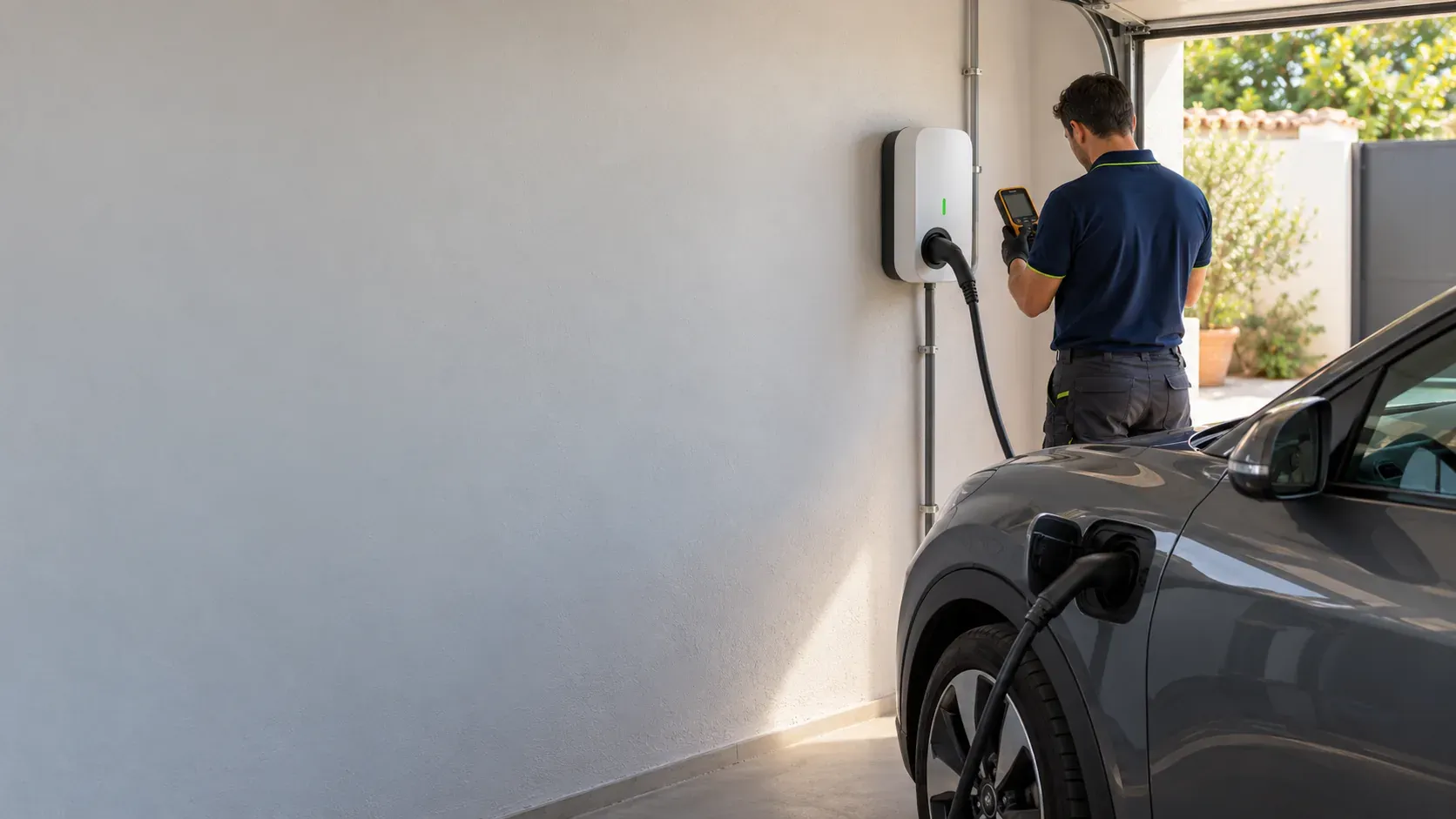
We handle EV charger installation in Seville, Spain, in your house, in your space in a communal garage, for the whole building or for your business, with a dedicated circuit, the protection devices required by ITC-BT-52, a registered boletín and the paperwork for the 15 % income tax deduction.
Services in this area
Home EV charger for houses
EV charger installation in Seville, Spain for your villa or townhouse is a one-day job: a dedicated circuit from your fuse board, its own protection devices, a 7.4 to 22 kW wallbox and a boletín registered with the Junta de Andalucía. In 2026 you can still deduct 15 % in your Spanish income tax return.
EV charger in a communal garage
An EV charger in a communal garage in Spain only requires you to notify the comunidad (the homeowners' association): no vote, no permission. We run the line from your meter to your parking space in Seville, install the charger with its protection devices and register the boletín.
Communal EV charging backbone
A communal EV charging pre-installation in your building's garage in Seville, Spain sorts out the wiring once and for all: one backbone line, one charging board and a load manager, so each neighbour can later connect their own charger paying only their share and their own electricity.
EV charging for businesses and fleets
We install fleet EV charging in Seville, Spain: chargers for your company vehicles, for staff and for the customer car park, with user management by card, power sharing and consumption tracking per vehicle. We also handle the engineering project and the legalisation.
EV charging for hotels and shops
An EV charger for hotels, restaurants and shops in Seville, Spain attracts customers who drive electric cars: they park, spend and leave with a fuller battery. We install chargers with payment by app or card and OCPP management, and we help you meet the compulsory minimum number of charging points.
Industrial estates and warehouses
We install EV charging for your industrial warehouse in Seville, Spain so you can charge the van fleet, company cars and your employees' cars: three-phase chargers of 11 to 22 kW, a load manager so you never exceed your contracted power and, if you have a roof, charging from your own solar panels.
Charging with management and payment
We install OCPP EV chargers in Seville, Spain connected to a management platform, so you can identify each user with an RFID card or an app, share the available power and charge for the energy: hotels, car parks, shops, companies with staff and residential communities that want shared charging.
Dynamic load balancing
EV charger dynamic load balancing in Seville, Spain measures what your home is using in real time and adjusts the charger so you never exceed your contracted power (potencia contratada). You charge the car without paying for more power and without the power limiter cutting everything off when the oven or the air conditioning comes on.
Solar EV charging
A solar EV charger in Seville, Spain lets you charge your electric car with the energy your roof does not use. We install the wallbox with its meter so it charges only from solar surplus, or from surplus plus a minimum from the grid, and if you do not have panels yet, we carry out the complete installation.
Bidirectional V2G and V2H charging
We install the circuit and the switchboard for a bidirectional V2G or V2H charger in Seville, Spain, the kind that lets your car battery power your home during a power cut or at night. V2H can already be installed with approved equipment; V2G, which exports to the grid, is still waiting for a specific payment scheme in Spain.
E-motorbike, e-bike and e-scooter
We install electric motorbike charging in your garage, storage room or parking space in Seville, Spain: a protected socket or a low-power charger with its own circuit breaker and RCD, fed from your own meter. It works for your e-bike and e-scooter too, without tapping into the electricity of the comunidad (the residents' association).
EV charger grants and tax relief
EV charger grants in Seville, Spain come down to one in 2026: the 15 % income tax (IRPF) deduction, worth up to 600 euros, for installations completed before 31 December 2026. MOVES III closed in 2025 and the Auto+ programme does not cover chargers. Here is how to make the most of the deduction.
EV charger repair
If you need EV charger repair in Seville, Spain, we diagnose the fault in the unit itself and in the installation that feeds it: protection devices, cable, connector, internet connection, load balancing and firmware. We work on any brand, whether we installed it or not.
EV charger brands we install
Choosing between EV charger brands in Spain is easier with an installer who is not selling one. In Seville we install the wallbox you choose, or the one that best suits your case: Wallbox, V2C, Circutor, Simon, Schneider, Tesla and other makes. We help you decide on technical grounds, not commercial ones: power, phases, load balancing, solar charging and management.
EV charger installation in Seville for every type of garage
Charging in the garage of a detached house is not the same as in the basement of a building with 200 spaces. That is why we study each case before giving a price:
- Home EV charger for a house: the charger runs from your own fuse board on a dedicated circuit. It is the simplest and most common installation in Mairena, Tomares, Bormujos or Montequinto. Market price 800 to 1,600 euros plus VAT, charger and installation included.
- EV charger in a communal garage: the usual solution is a line from your meter, in the building’s meter room, to your space. Price 1,200 to 2,200 euros depending on distance and whether a conduit is already in place.
- Pre-installation for the whole building: a trunk line with a load manager that each owner connects their charger to. It keeps the garage free of dozens of separate cables and protects the building’s supply. Around 3,000 to 8,000 euros, shared between owners.
- Businesses, hotels, shops and industrial estates: several charging points, user management by card or app and three-phase chargers of 11 to 22 kW.
What ITC-BT-52 requires
EV charging has its own technical instruction in Spain, ITC-BT-52 (Royal Decree 1053/2014). A properly installed charger has:
- A dedicated circuit from the fuse board or from the meter, with nothing else connected.
- A 30 mA Type A RCD with 6 mA DC detection, or a Type B RCD.
- A C-curve circuit breaker sized for the power and the cable length.
- A surge protector, highly advisable in Seville because of summer storms.
- Cable of the right cross-section: the longer the run, the thicker the cable, to avoid voltage drop.
At home you charge in mode 3 with a Type 2 connector. The usual power is 7.4 kW single-phase, which adds roughly 40 to 45 km of range per hour, or 11 or 22 kW if you have a three-phase supply. With dynamic load balancing the charger adapts to what the house is using, so you do not have to push up your bill by raising your potencia contratada.
Do I need the comunidad’s permission?
No. If you live in a block of flats, the comunidad de propietarios (owners’ association, HOA in US terms) runs the building and its garage, but for an individual space you only need to notify the president or the property administrator in advance (article 17.5 of the Horizontal Property Law), and the Supreme Court confirmed it in December 2025 even when the cable runs through communal areas. The law sets no deadline: leaving around 30 days is only a recommended practice so the comunidad can arrange access to the meter room. What the comunidad can ask is that a registered installer does the work, that existing conduits are respected and that you do not connect to the communal services meter.
Grants in 2026: the 15 % income tax deduction
MOVES III stopped accepting applications on 31 December 2025, and the Auto+ programme (Royal Decree 609/2026) only subsidises vehicles. What remains is the 15 % deduction in personal income tax (IRPF, Royal Decree-law 7/2026) for chargers installed by 31 December 2026: a maximum base of 4,000 euros, a saving of up to 600 euros, in a property you own, paid by transfer or card and with a registered installer. Prices for each case are on the prices page, along with the full conditions of the deduction.
Smaller and more technical charging jobs
Alongside the installations above, we take on smaller or more technical jobs:
- Reinforced 16 A socket with its own circuit and protection devices, for a plug-in hybrid or a motorbike: 200 to 450 euros.
- Activating the EV pre-installation of a new-build home: since 2022, new residential buildings have conduits to every space (CTE HE 6) but no cable and no charger. Pulling the cable and fitting the protection devices and the charger costs 1,250 to 1,450 euros depending on the distance. If you have just got the keys, see our new-build section.
- Notice to the comunidad: we prepare the technical details the letter should include (space, cable route, charger and installation company).
- A separate meter in the garage when your space is very far from your meter or you do not live in the building.
- Solar charging: chargers that use the surplus from your solar panels, explained in solar EV charging.
- Dynamic load balancing module: 150 to 400 euros plus installation, when your contracted power is tight.
Prices and related specialities
Guide prices for each case are on the prices page. Charging often goes together with solar and energy efficiency, with the garage and meter room work we do for homeowners’ associations and, when the supply falls short, with the power and fuse board upgrades in electrical installations. The other specialities are in services.
Frequently asked questions
How much does it cost to install a home EV charger in Seville, Spain?
In a house with a single-phase supply, the market price is 800 to 1,600 euros plus VAT, including the charger and installation. In a communal garage space it is usually 1,200 to 2,200 euros, depending on the distance to your meter and whether the building has pre-installation. We give you a fixed price after seeing the cable route.
Do I need permission from the comunidad to install a charger in my space?
No. Article 17.5 of the Horizontal Property Law only requires you to notify the president or the property administrator beforehand. The Spanish Supreme Court, in its ruling of 1 December 2025, confirmed that no authorisation is needed even if the cable runs through communal areas, unless the impact is disproportionate.
Are there grants for EV chargers in Spain in 2026?
For individuals, the only one still available is the 15 % income tax (IRPF) deduction, until 31 December 2026, with a maximum base of 4,000 euros (a saving of up to 600 euros). MOVES III closed applications on 31 December 2025, and the Auto+ programme subsidises cars, not chargers.
Do I need to increase my contracted power to charge the car?
Not always. With 4.6 kW contracted you cannot charge at 7.4 kW without dynamic load balancing, which lowers the charger's power when the house uses more. With balancing you can charge without the power-limiting switch cutting out; another option is to raise only the off-peak (valle) power to charge at night.
Need an electrician in Seville, Spain?
Call us or send a WhatsApp message with a photo of the job. You get a fixed quote before any work starts.