

EV chargers
EV charger dynamic load balancing in Seville, Spain: charge the car without raising your potencia
EV charger dynamic load balancing in Seville, Spain measures what your home is using in real time and adjusts the charger so you never exceed your contracted power (potencia contratada). You charge the car without paying for more power and without the power limiter cutting everything off when the oven or the air conditioning comes on.
EV charger dynamic load balancing: what it is and why you almost always need it
Almost every home in Seville has a single-phase supply, and contracted powers (potencia contratada) of 4.6 or 5.75 kW are very common. A 7.4 kW electric car charger on its own already exceeds those figures. Add the oven, the induction hob or the air conditioning in August and the power control switch (ICP, now built into the smart meter) cuts out and you are left in the dark.
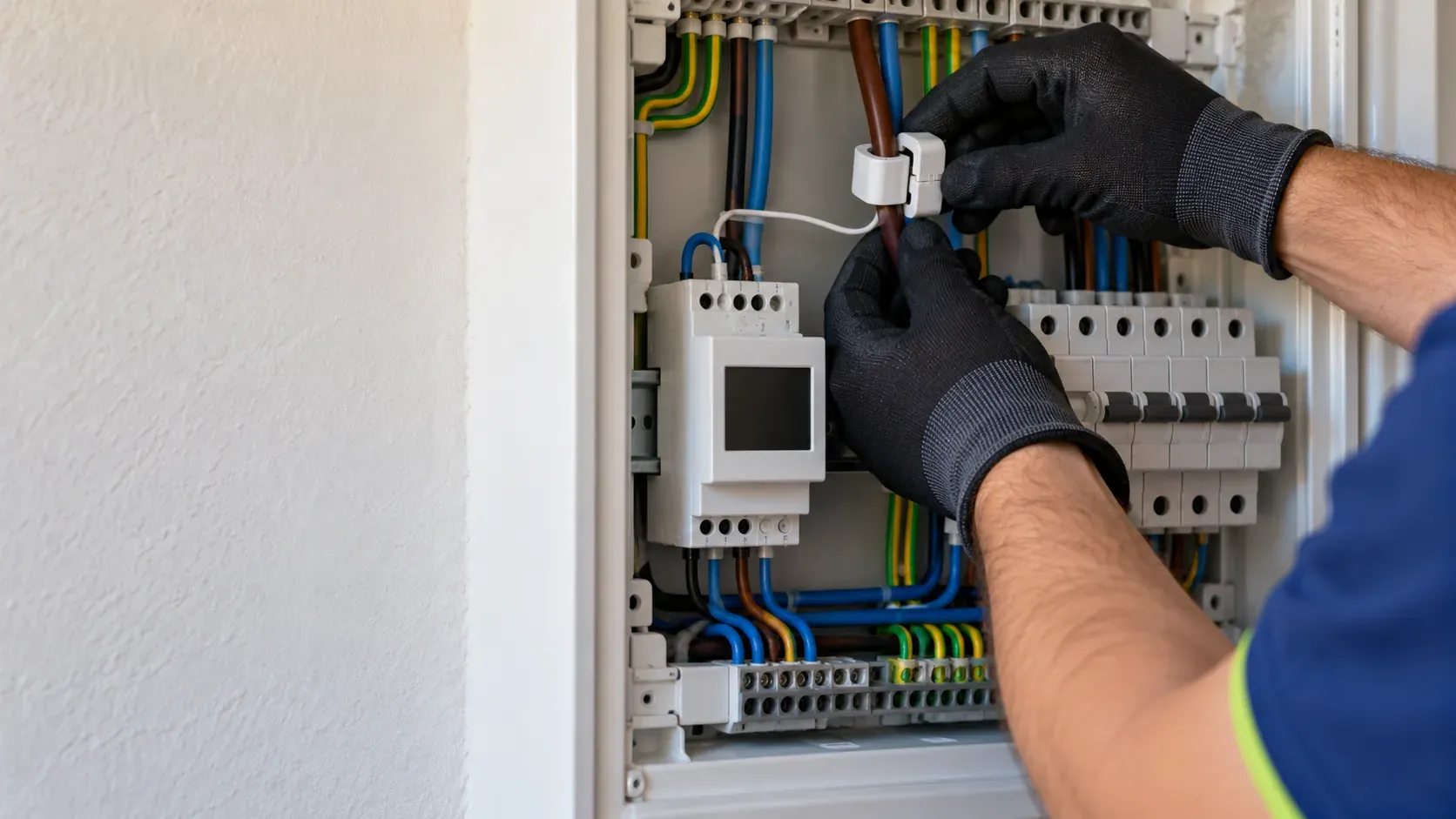
If you come from the UK or the US, this is the part of the Spanish system that surprises people most: your home does not simply draw what it needs, it is capped at the kW you pay for each month. Dynamic load balancing for your wallbox avoids that cut. A meter (a current clamp or a meter with Modbus communication) is fitted where the supply enters your installation and tells the charger, second by second, how much the home is using. The charger adjusts its current so that home plus car never exceeds your contracted power. Charging adapts, but the lights stay on.
Charge your car without raising your potencia
With load balancing you can charge your car without increasing your contracted power in most cases. At night, when the home uses very little, the charger works close to its maximum. In the evening, if you are cooking or running the washing machine, it reduces charging and catches up later. The charging standard sets a minimum of 6 A (about 1.4 kW) so the car keeps charging.
If you drive a lot and want to charge faster, the 2.0TD tariff lets you contract a different power in the peak and off-peak periods. Many owners raise only the off-peak power, from 00:00 to 08:00 and all weekend, which is the cheapest, and keep load balancing as protection. If you still need more power at any time of day, we help you increase your contracted power with its boletín (the electrical installation certificate).
Cheap night-time charging
Load balancing works well with scheduled charging. From the charger or car app you set it to charge only in the off-peak period. With a price of 0.08 to 0.15 euros per kWh off-peak, charging costs around 1.8 euros per 100 km, compared with 9 to 11 euros in petrol (gas). For 15,000 km a year, that is about 20 to 30 euros a month of electricity.
What each manufacturer calls it
Almost all mid-range and high-end chargers accept load balancing with an external meter, although each brand gives it a different name:
- Wallbox: Power Boost for balancing against the home, and Power Sharing for sharing power between several chargers.
- V2C Trydan: dynamic meter, which also allows charging from solar surplus.
- Circutor eHome Link: version with built-in load balancing.
- Tesla Wall Connector: load balancing with a compatible external meter.
We explain the differences between models on our EV charger brands page.
How we install it
- We review your contracted power and your real consumption, plus the charger model you have or are about to buy.
- We fit the meter in the main fuse board or on the individual supply cable (derivación individual), depending on where your meter is.
- We link meter and charger by cable or wirelessly. In garages with poor signal, a cable is the reliable option.
- We set the maximum power and check with a real load that the power limiter does not trip when the heaviest appliances come on.
- We show you the app to schedule charging and see your consumption.
Guide prices
| Job | Guide price (plus 21 % VAT) |
|---|---|
| Dynamic load balancing module (meter or clamp) | 150 to 400 euros plus fitting (181.50 to 484 euros with VAT) |
| Charger with load balancing in a house | within the 800 to 1,600 euros of the complete charging point |
| Charger with load balancing in a communal garage | within the 1,200 to 2,200 euros of the complete charging point |
If load balancing is fitted with the charger, it is included in the fixed quote for the charging point. All our rates are on the prices page.
Where it is essential
- In flats in Nervión, Los Remedios or Triana, in blocks from the 1960s and 1970s with low contracted power, where increasing power is not always possible without building work.
- In a communal garage, when the charger is fed from your flat meter and the space is far away: a trip means going upstairs to reset it. The technical guide to ITC-BT-52 specifically recommends load balancing in this case.
- In villas in Sevilla Este, Dos Hermanas or the Aljarafe with air conditioning, a pool and a heat pump: a house uses a lot of power in summer and load balancing shares it out.
If your ICP already trips often, read our page on what to do when the power limiter keeps tripping. You will find every other option on the EV charger installation page.
Where we do this most
Electrician in Nervión, Seville, Spain: 1960s and 1970s flats, rewiring and RCD faults
Electrician in Los Remedios, Seville, Spain: more power, fuse boards and earthing
Electrician in Triana, Seville, Spain: patio houses, riverside damp and bars
Electrician in Sevilla Este, Seville, Spain: EV chargers and brand-new flats
Electrician in Dos Hermanas, Seville, Spain: the town, Montequinto and Entrenúcleos
Electrician in Mairena del Aljarafe, Seville, Spain: flats, villas and new builds
Electrician in Tomares, Seville, Spain: villas, pools, solar panels and EV chargers
Frequently asked questions
What is dynamic load balancing for an EV charger?
It is a meter fitted where the supply enters your installation that tells the charger, at every moment, how much the home is using. The charger lowers or raises its power so that the total never goes above your contracted power and the power limiter (ICP) does not cut the electricity.
Do I need it if I have 4.6 kW contracted?
Yes. With 4.6 kW you cannot charge at 7.4 kW without load balancing, because the charger on its own already exceeds your power. With the module, the car charges with whatever is spare at each moment: more slowly when the home is busy and at full speed when it is not.
Is load balancing better than increasing my potencia?
It depends on your consumption and your routine. Increasing power has a fixed yearly cost (around 30 euros per kW per year on the 2.0TD tariff) and sometimes requires a boletín. Load balancing is a one-off cost. Often the best option is both: load balancing plus raising only the off-peak power.
Can I add load balancing to a charger I already have?
In most cases yes, if the charger accepts an external meter. We check the model and firmware version, install the meter or clamp in the fuse board (breaker panel), connect it to the charger by cable or wirelessly and set it up with your contracted power.
How long does charging take with load balancing?
At night, with the home almost idle, the charger works close to its maximum: at 7.4 kW a 60 kWh battery goes from 20 to 80 % in about 5 hours. If you switch appliances on during that time, charging slows and takes a little longer, but the power never goes off.
Does load balancing work in a communal garage?
It is almost essential there. If your charger is fed from your flat meter and the space is far away, a trip of the power limiter means going upstairs to reset it. With load balancing that does not happen. On shared communal backbones, a load manager also shares the power between all the chargers.
Related services
Home EV charger for houses
EV charger installation in Seville, Spain for your villa or townhouse is a one-day job: a dedicated circuit from your fuse board, its own protection devices, a 7.4 to 22 kW wallbox and a boletín registered with the Junta de Andalucía. In 2026 you can still deduct 15 % in your Spanish income tax return.
EV charger in a communal garage
An EV charger in a communal garage in Spain only requires you to notify the comunidad (the homeowners' association): no vote, no permission. We run the line from your meter to your parking space in Seville, install the charger with its protection devices and register the boletín.
Solar EV charging
A solar EV charger in Seville, Spain lets you charge your electric car with the energy your roof does not use. We install the wallbox with its meter so it charges only from solar surplus, or from surplus plus a minimum from the grid, and if you do not have panels yet, we carry out the complete installation.
EV charger brands we install
Choosing between EV charger brands in Spain is easier with an installer who is not selling one. In Seville we install the wallbox you choose, or the one that best suits your case: Wallbox, V2C, Circutor, Simon, Schneider, Tesla and other makes. We help you decide on technical grounds, not commercial ones: power, phases, load balancing, solar charging and management.
Increase contracted power
You need to increase your electricity power in Spain when the smart meter cuts everything off as soon as the air conditioning, the oven and the washing machine run together. We check what power your installation can take, upgrade the supply cable, main switch and fuse board if needed, and issue the boletín so the distributor approves the increase.
Power limiter tripping
If your smart meter keeps cutting the power when you switch several things on at once, the ICP power limiter is tripping because you are exceeding your contracted power (potencia contratada). We review your consumption and your installation and tell you whether organising your appliances is enough or whether it is worth increasing the power in Seville, Spain.
Need an electrician in Seville, Spain?
Call us or send a WhatsApp message with a photo of the job. You get a fixed quote before any work starts.