

EV chargers
EV charger installation for your house in Seville, Spain
EV charger installation in Seville, Spain for your villa or townhouse is a one-day job: a dedicated circuit from your fuse board, its own protection devices, a 7.4 to 22 kW wallbox and a boletín registered with the Junta de Andalucía. In 2026 you can still deduct 15 % in your Spanish income tax return.
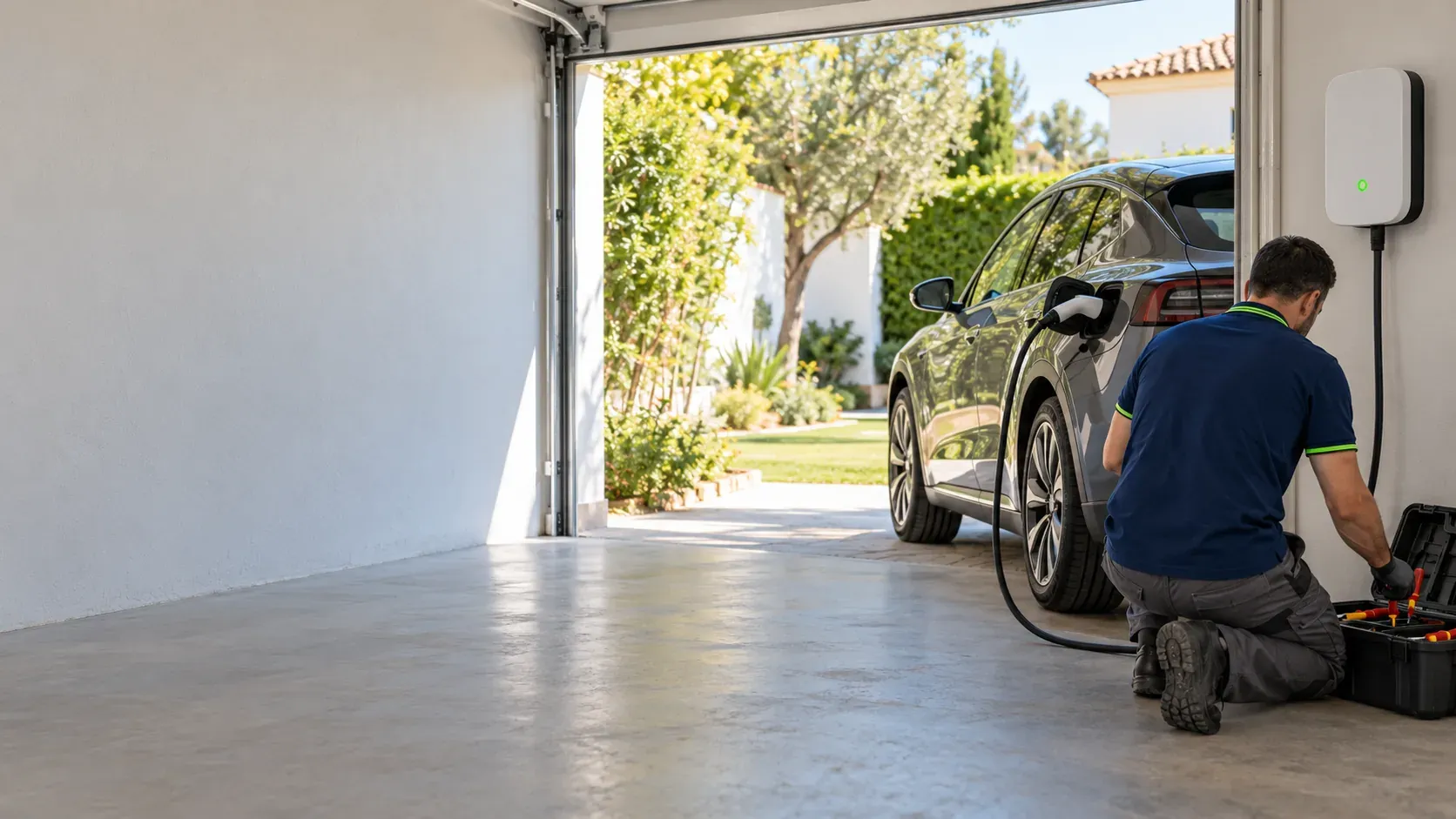
EV charger installation in Seville for houses with their own garage
If you live in a detached villa, a semi-detached house or a townhouse with a garage or a parking space inside your plot, the charger is fed from your own fuse board. You do not need anyone’s permission or to notify a homeowners’ association (comunidad), and the job is simpler and cheaper than in a shared garage. If what you have is a space in the basement garage of a block of flats, the case is different and we explain it on the page about an EV charger in a communal garage.
What we install is a wallbox, the wall-mounted charger that the Spanish regulation calls SAVE (specific power supply system for electric vehicles). It charges in mode 3, which means the charger talks to the car before supplying current, with a Type 2 connector, the European standard used by every electric car and plug-in hybrid sold in Spain. If you have brought a car from the UK or the US, check its socket and on-board charger with us first.
What the charging point installation includes
- Technical visit beforehand. We look at your fuse board, the contracted power, the type of supply (single-phase or three-phase), the route to the garage and the place where you park.
- Dedicated charging circuit. A new line from the house fuse board to the charger, with no other loads on it, and a cable size calculated for the distance.
- Its own protection devices. Type C circuit breaker, 30 mA type A RCD with 6 mA DC detection (or a type B RCD) and a surge protector.
- The charger. Fixed to a wall or a pillar at a comfortable height, with tethered cable or socket, and set up in the manufacturer’s app.
- Dynamic load balancing when your contracted power requires it, so the meter never cuts the supply.
- Boletín and technical report registered with the Industry Delegation of the Junta de Andalucía.
- Itemised invoice with everything you need to claim the 15 % deduction in your income tax return.
Which charger power to choose
| Power | Supply | Range added per hour | Who it suits |
|---|---|---|---|
| 3.7 kW | Single-phase, 16 A | about 20 km | Plug-in hybrids and low contracted power |
| 7.4 kW | Single-phase, 32 A | 40 to 45 km | The standard for a house: 20 to 80 % of a 60 kWh battery in about 5 hours |
| 11 kW | Three-phase, 16 A | about 60 km | Homes with a three-phase supply |
| 22 kW | Three-phase, 32 A | about 120 km | Specific cases: few cars charge at 22 kW on AC |
Almost every home in Seville has a single-phase supply, so a 7.4 kW charger is the norm. With it, the car you plug in when you get home in the evening is full by the morning within the off-peak period, when electricity is cheapest. If your villa has a three-phase supply, for example because you have an aerothermal heat pump or a large pool pump, you can go up to 11 kW.
Contracted power and dynamic load balancing
A 7.4 kW charger on its own uses more than many homes have contracted. With 4.6 kW of contracted power (potencia contratada), if you switch on the oven while the car is charging, the power limiter in the meter cuts everything off. There are two solutions, and they are often combined:
- Dynamic load balancing. A meter in the fuse board tells the charger what the house is using at each moment, and the charger lowers or raises its power so it never exceeds the contracted power. It is built into or supported by chargers from Wallbox (Power Boost), V2C (Trydan), Circutor (eHome Link) and the Tesla Wall Connector with its meter.
- Increase only the off-peak power. In the 2.0TD tariff you can contract a different power for peak hours and for off-peak hours. Many users raise only the off-peak power and charge at full speed at night.
If you would rather raise the power for the whole house, see increase your contracted power, and if your fuse board is old or full, fuse board replacement.
How we work
- You send us photos of the fuse board, the meter and the place where you park, and we give you a first price guide.
- Technical visit to measure the real cable route, check the power and choose the installation scheme.
- Fixed written quote, with the metres included and any possible extras shown, so there are no surprises.
- Installation in one day: conduit, protection board, charger, set-up and a test charge with your car.
- Boletín and documents: we register the certificate with the industry department and hand you the invoice and the certificate for your tax return.
Price of installing an EV charger in Seville
| Job | Guide price (plus 21 % VAT) | Total with VAT |
|---|---|---|
| Heavy-duty 16 A socket with its own circuit and protection | 200 to 450 euros | 242 to 544.50 euros |
| Single-phase wallbox from 3.7 to 7.4 kW, short cable run | 800 to 1,600 euros | 968 to 1,936 euros |
| Typical case with the fuse board close to the garage | 1,000 to 1,200 euros | 1,210 to 1,452 euros |
| Smart wallbox with boletín | 1,200 to 1,500 euros | 1,452 to 1,815 euros |
| Three-phase wallbox from 11 to 22 kW | 1,600 to 2,800 euros | 1,936 to 3,388 euros |
| Annual check of the charging point | 80 to 150 euros | 96.80 to 181.50 euros |
Prices include charger and installation. What moves the price most is the distance between the fuse board and the garage, passing through floors or walls and the charger model. The full price list is on our prices page.
The 15 % income tax deduction in 2026
Royal Decree-law 7/2026, of 20 March, extended until 31 December 2026 the 15 % deduction in Spanish personal income tax (IRPF) for installing an EV charging point. If you file a Spanish tax return, these are the conditions:
- The maximum base is 4,000 euros, so the most you can deduct is 600 euros.
- The installation must be completed before 31 December 2026, and the deduction is applied in the return for the year it is completed (the 2026 return, filed in 2027).
- The home must be yours and not used for a business activity.
- Payment cannot be in cash: bank transfer, card or payment into an account.
- The installation must be done by a registered installer company, and the return states the cost, the date and the installer’s tax number (NIF).
The MOVES III programme no longer accepts applications and the Auto+ Programme does not cover the charger, even though some websites still advertise it.
Regulations: what ITC-BT-52 requires
EV charging is regulated by ITC-BT-52 of the Low Voltage Electrotechnical Regulation, approved by Royal Decree 1053/2014. In a house the usual layout is scheme 4a: an additional, dedicated circuit for charging, called C13, coming from the main fuse board of the home. When the board is far from the garage, scheme 2 can be used, with the line coming from the meter.
The regulation also requires:
- Individual 30 mA RCD protection, at least class A. We recommend 6 mA DC detection, which almost all good-quality wallboxes have built in, or a type B RCD.
- Surge protection, highly advisable in Seville because of summer storms and the value of the car plugged in.
- A maximum voltage drop of 5 % up to the charging point, which means increasing the cable size with distance: 6 mm2 up to about 15 metres and 10 mm2 from 15 to 30 metres, as a usual rule.
- An installation certificate and a technical design report. An engineer’s project is only needed if the charging infrastructure exceeds 50 kW, which never happens in a house.
Villas and townhouses in Seville and the Aljarafe
We install chargers in houses across the area: the Aljarafe (Tomares, Mairena, Bormujos, Espartinas, Gines), Montequinto and Entrenúcleos, Alcalá de Guadaíra and the housing estates of Sevilla Este and Valdezorras. Each type of house has its own detail:
- New-build villas. Recent developments of houses, such as the Enea semi-detached homes in Entrenúcleos, the Guiomar townhouses in Bormujos, Villas del Támesis and Villas del Tíber in Palmas Altas or the Altos del Aire homes in Tomares, have a new fuse board that is usually close to the garage. It is the quickest installation. More on Entrenúcleos and Palmas Altas and Isla Natura.
- Townhouses from the 1990s and 2000s. The fuse board is often in the kitchen or the hall and the garage at the other end, with floors in between. Here the route sets the price, and sometimes a well-finished surface conduit is the best option.
- Villas with a plot. If you park outside, under a porch or by the gate, the charger goes outdoors with a buried line or a line along the facade and a weatherproof model.
See also our area pages for Tomares, Mairena del Aljarafe, Bormujos and the Aljarafe north.
Charging with your solar panels
Seville has around 3,000 hours of sunshine a year, and each kWp of panels produces roughly 1,600 to 1,750 kWh. A car that covers 15,000 kilometres uses 2,400 to 2,550 kWh a year, so about 2 kWp of extra panels cover almost all of it if you charge during the day. To take advantage of this you need a charger that works in surplus mode, such as the Wallbox Eco-Smart, the V2C Trydan or the Circutor eHome. If you already have panels or are thinking of fitting them, see solar panels.
How much it costs to charge the car at home
An electric car uses 16 to 18 kWh every 100 kilometres. With a tariff that has a cheap off-peak period, charging at home costs about 1.8 euros per 100 kilometres, compared with 9 to 11 euros for a petrol car. For 15,000 kilometres a year, the electricity bill goes up by about 20 to 30 euros a month on an off-peak tariff. That saving, plus the income tax deduction, is what makes the charger pay for itself quickly. All charging cases, from houses to businesses, are on the EV charger installation page.
EV charger price calculator
A guide based on 2026 market prices in Spain. You get a fixed quote once we have seen your garage.
Guide price with smart charger, installation, protection devices and boletín
1.300 €
With the 15 % income tax deduction (until 31 December 2026), it would cost you about 1.105 €.
Over 30 metres needs a thicker cable. For three phase we show the market range. Guide market prices, not an offer.
Where we do this most
Electrician in the Aljarafe, Seville, Spain: Castilleja, Gines, Espartinas and more
Electrician in Tomares, Seville, Spain: villas, pools, solar panels and EV chargers
Electrician in Mairena del Aljarafe, Seville, Spain: flats, villas and new builds
Electrician in Bormujos, Seville, Spain: townhouses, gardens and EV chargers
Electrician in Dos Hermanas, Seville, Spain: the town, Montequinto and Entrenúcleos
Electrician in Sevilla Este, Seville, Spain: EV chargers and brand-new flats
Frequently asked questions
How much does it cost to install a home EV charger in Spain?
In a single-phase house, 800 to 1,600 euros plus 21 % VAT including charger and installation; the typical case, with the fuse board close to the garage, is 1,000 to 1,200 euros plus VAT. With a three-phase supply and an 11 or 22 kW charger, 1,600 to 2,800 euros plus VAT. We give you a fixed written price after seeing the board and measuring the route.
Can I charge my car from a normal socket in the garage?
Occasionally, yes, with the mode 2 cable that comes with the car and limited to 10 A (2.3 kW). For daily use it is not advisable: a household Schuko socket is not designed to carry that current for ten hours in a row, it heats up and has no protection of its own. The right solution is a wallbox or, at least, a heavy-duty socket with its own circuit and protection.
Do I have to increase my contracted power (potencia)?
Not always. With a charger that has dynamic load balancing, it charges with the power left over at each moment and the meter never cuts the supply. If you want to charge at 7.4 kW at any time and you have 4.6 kW contracted, in the 2.0TD tariff you can increase only the off-peak power, which is the cheapest, and charge at night.
What charger power is right for me?
In a house with a single-phase supply, 7.4 kW is the standard: it adds about 40 to 45 kilometres of range per hour of charging. For a plug-in hybrid 3.7 kW is enough. 11 and 22 kW chargers only make sense if your home is three-phase, and few cars accept 22 kW on alternating current.
How long does the installation take?
The work in a house is done in one day in most cases. Afterwards we register the boletín and the technical report with the regional industry department, which usually takes 5 to 15 days. If the power has to be increased, the distributor adds its own timescale.
Can I install the wallbox myself?
No. A charging point must be installed by a registered low voltage installer company, which issues the electrical installation certificate (boletín) and registers it with the Junta de Andalucía. Without that certificate there is no income tax deduction, the manufacturer may refuse the warranty and your home insurance may not cover a claim.
Are there EV charger grants in Spain in 2026?
The MOVES III programme closed applications on 31 December 2025, and the Auto+ Programme only subsidises buying the car, not the charger. What remains in force is the 15 % income tax (IRPF) deduction, up to 600 euros, for installations completed before 31 December 2026.
Can I charge the car with my solar panels?
Yes, with a compatible charger that reads the home's consumption and charges only with the surplus from the panels, or with surplus plus a minimum from the grid. In Seville, about 2 kWp of extra panels cover roughly the 15,000 kilometres a year of one car if you charge during the day.
Can I charge outdoors or in the rain?
Yes. Wallboxes and Type 2 connectors have an IP54 rating or higher, and charging does not start until the cable is locked and checked. If the charger goes under a porch or on the front of the house, we choose a model suitable for outdoor use. What you must never do is charge through extension leads or power strips.
What happens to the charger if I sell the house?
The charger can be removed and taken to your new home, with a new boletín at the new location. The fixed installation, the cable and the protection board, usually stays in the house, and a garage ready for charging adds value when you sell or rent it out.
Related services
EV charger in a communal garage
An EV charger in a communal garage in Spain only requires you to notify the comunidad (the homeowners' association): no vote, no permission. We run the line from your meter to your parking space in Seville, install the charger with its protection devices and register the boletín.
Dynamic load balancing
EV charger dynamic load balancing in Seville, Spain measures what your home is using in real time and adjusts the charger so you never exceed your contracted power (potencia contratada). You charge the car without paying for more power and without the power limiter cutting everything off when the oven or the air conditioning comes on.
Solar EV charging
A solar EV charger in Seville, Spain lets you charge your electric car with the energy your roof does not use. We install the wallbox with its meter so it charges only from solar surplus, or from surplus plus a minimum from the grid, and if you do not have panels yet, we carry out the complete installation.
EV charger grants and tax relief
EV charger grants in Seville, Spain come down to one in 2026: the 15 % income tax (IRPF) deduction, worth up to 600 euros, for installations completed before 31 December 2026. MOVES III closed in 2025 and the Auto+ programme does not cover chargers. Here is how to make the most of the deduction.
EV charger brands we install
Choosing between EV charger brands in Spain is easier with an installer who is not selling one. In Seville we install the wallbox you choose, or the one that best suits your case: Wallbox, V2C, Circutor, Simon, Schneider, Tesla and other makes. We help you decide on technical grounds, not commercial ones: power, phases, load balancing, solar charging and management.
Solar panels for self-consumption
We install solar panels in Seville, Spain and the surrounding province on a turnkey basis: we study your consumption and your roof, fit panels, inverter and protection devices, and handle the legalisation and the compensation for your surplus energy. With Seville's sunshine, each kW installed saves an average of about 189 euros a year.
Need an electrician in Seville, Spain?
Call us or send a WhatsApp message with a photo of the job. You get a fixed quote before any work starts.