
Solar and efficiency
Solar panels for self-consumption in Seville, Spain: turnkey installation
We install solar panels in Seville, Spain and the surrounding province on a turnkey basis: we study your consumption and your roof, fit panels, inverter and protection devices, and handle the legalisation and the compensation for your surplus energy. With Seville's sunshine, each kW installed saves an average of about 189 euros a year.
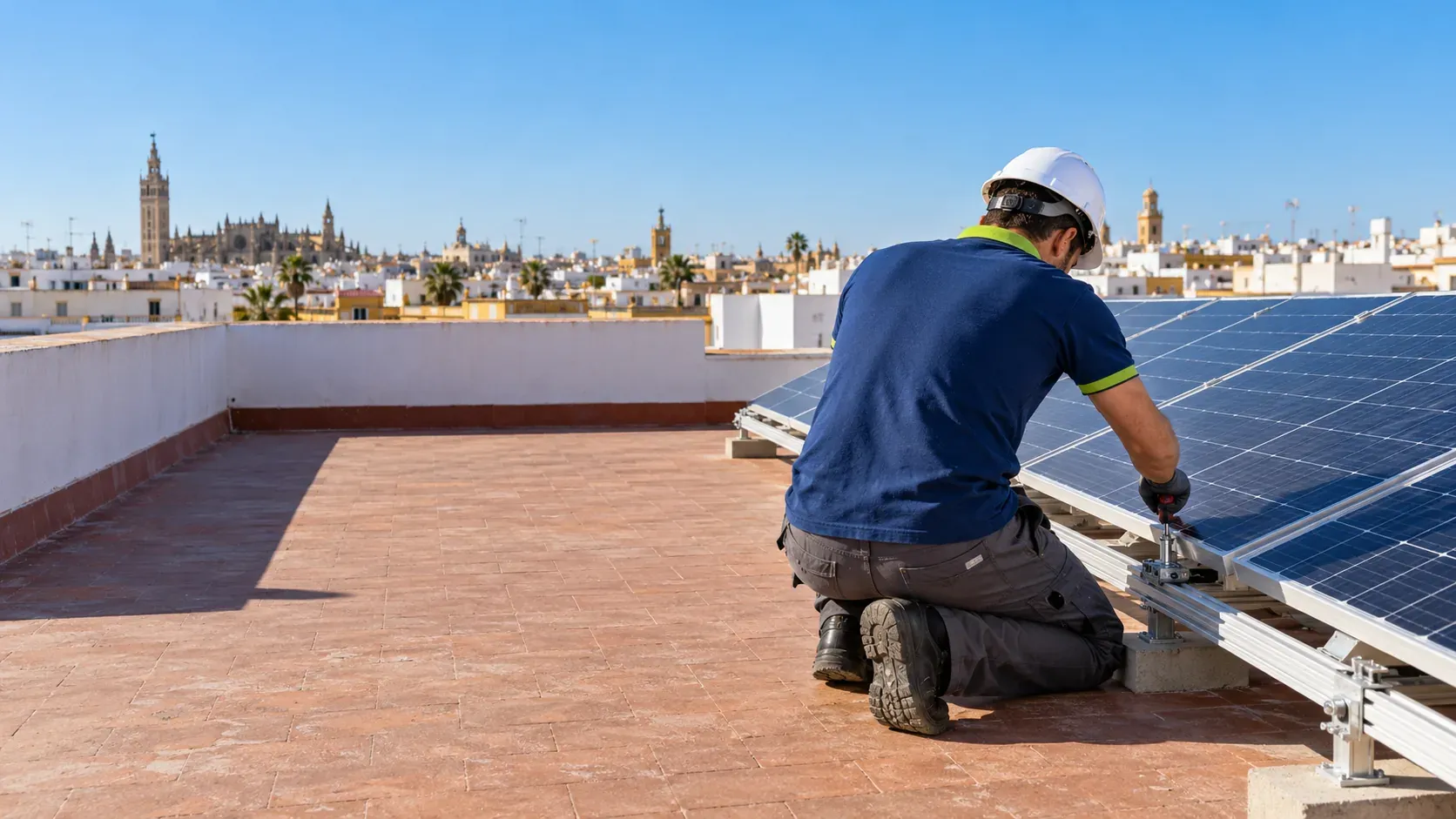
Solar panels in Seville: why they work so well here
Seville has around 3,000 hours of sunshine a year, and each kWp of panels produces roughly 1,600 to 1,750 kWh a year. On top of that, the heaviest consumption here, air conditioning in summer, coincides with the sunniest hours, so much of what the panels produce is used straight away, which is when you save the most.
We carry out turnkey installations: from the study of your consumption and your roof to the legalisation and the registration of surplus compensation with your supplier. All you have to decide is the size and, if you want one, the battery.
Self-consumption in Spain, explained
In Spanish, rooftop solar for your own use is called autoconsumo (self-consumption), and the energy you do not use is called excedentes (surplus). The rules come from Royal Decree 244/2019, the current framework for self-consumption. In practice:
- You use your own solar energy first. Whatever the house consumes while the panels produce is energy you do not buy.
- The surplus goes to the grid. With the simplified compensation scheme, your supplier deducts it from your bill each month, at a lower price than the energy you buy.
- Your contract stays with your supplier (Endesa, Iberdrola, Naturgy, Octopus or any other), and the meter belongs to the distributor, e-distribución in Seville. We handle the paperwork with both.
What the solar panel installation includes
- Preliminary study. We analyse a year of electricity bills, the orientation and pitch of the roof, shading and the space available, and suggest the power that suits you best.
- Panels and structure. Mounting on tiles, metal sheet or a flat roof, with the right structure and fixings that respect the waterproofing.
- Inverter. The unit that converts the direct current from the panels into the alternating current your home uses, with monitoring on your phone.
- Protection devices. DC and AC protection, a surge protector and connection to the home’s fuse board.
- Battery, if you want one, to store the daytime surplus and use it at night.
- Legalisation. Technical report or project depending on the power, installation certificate registered with the Junta de Andalucía and paperwork with the distributor and the supplier to compensate the surplus.
- Commissioning and an explanation of the app so you can see what you produce and what you use.
What size of system do you need?
Your consumption decides it, not the size of the roof. That is why we always start with a year of bills: how much you use, at what times and in which months. As a guide:
- Detached house with air conditioning. Usually a 4 to 5 kW system, which covers much of the home’s consumption with a well-oriented roof.
- Detached house with an aerothermal heat pump, a pool or an electric car. Systems of 6 kWp or more, often with a battery for the afternoon and evening.
- Flats. In a block of flats the roof is a common element and the natural route is collective self-consumption with the other neighbours.
An electric car that covers 15,000 kilometres a year uses 2,400 to 2,550 kWh: with about 2 kWp of extra panels you cover almost all of it if you charge during the day. If that interests you, see home EV charger installation.
Solar panels in Seville: guide prices
| System | Guide price (plus 21 % VAT) | Total with VAT |
|---|---|---|
| Per kWp installed | 850 to 1,300 euros | 1,028.50 to 1,573 euros |
| 5 kW system on a detached house | 5,500 to 7,000 euros | 6,655 to 8,470 euros |
| 6 kWp with a 5 kWh battery | 10,000 to 14,000 euros | 12,100 to 16,940 euros |
| Annual maintenance check | 120 to 300 euros | 145.20 to 363 euros |
| Electrical side of an aerothermal heat pump | 300 to 800 euros | 363 to 968 euros |
| Study of contracted power and tariff | 50 to 150 euros | 60.50 to 181.50 euros |
The final price depends on the type of roof, the distance between the roof and the fuse board, the panels and inverter chosen and whether you add a battery. Other rates are on our prices page.
Savings and payback
Average savings in residential self-consumption were 189 euros per kW installed per year in 2025, according to APPA Fotovoltaico. For a 5 kW system that is about 945 euros a year, so an investment of 5,500 to 7,000 euros pays for itself in around six or seven years. From then on, the energy from the panels is practically free for the rest of their useful life.
How to get the most from your savings:
- Use electricity during the day. Programme the washing machine, dishwasher, water heater and pool pump for the sunny hours.
- Make the most of the climate. Air conditioning and aerothermal heat pumps run exactly when the panels produce.
- A battery for the evening. In Seville consumption rises at dusk; the battery shifts the midday surplus to then. In 2025, 61 % of new residential systems already had a battery according to UNEF, and installed battery capacity grew by 65 %.
- Adjust your contracted power once you see your new real consumption.
How we work
- You send us your bills and photos or the location of the roof.
- Study and proposal with the power, estimated production, saving and payback period.
- Technical visit to confirm the roof, shading, cable route and the condition of the fuse board. If the board needs updating, see fuse board replacement.
- Fixed quote with all equipment and legalisation included.
- Installation of panels, inverter and protection devices, with a functional test.
- Legalisation and registration of surplus compensation, and handover of the documents.
Self-consumption regulations
- Royal Decree 244/2019: regulates self-consumption, its modalities (without surplus and with surplus, with or without compensation) and collective self-consumption. Royal Decree-law 20/2022 extended the maximum distance between the installation and the associated consumers from 500 to 2,000 metres.
- ITC-BT-40 of the REBT: low voltage generating installations, with their protection and connection to the indoor installation.
- Royal Decree 1699/2011: grid connection of small installations.
- ITC-BT-04: technical design report for the usual home installations and an engineer’s project from 10 kW.
- CTE HE 5: minimum contribution of renewable electricity in certain new buildings.
The installation is carried out by a registered installer company, which issues the certificate and registers it with the industry department of the Junta de Andalucía. Surge protection is required in solar PV, and DC protection devices must be specific to that use.
Where we install: Aljarafe villas, Dos Hermanas and new builds
- Villas and townhouses in the Aljarafe. In Tomares, Mairena, Bormujos, Espartinas, Gines or Palomares del Río there are many well-oriented roofs and homes with air conditioning and a pool, the ideal profile. More on the Aljarafe north, Tomares, Mairena del Aljarafe and Bormujos.
- Dos Hermanas, Montequinto and Entrenúcleos. Developments of houses, such as the Insur villas in Entrenúcleos or the Enea semi-detached homes, allow a 4 to 5 kW system on the roof. More on Dos Hermanas and Entrenúcleos.
- New homes with an A energy rating. Some developments already come with solar PV, such as Alvareda by Habitat in Entrenúcleos, with solar PV and an aerothermal heat pump. In blocks of flats, solar PV is usually communal, on the building roof.
- Alcalá de Guadaíra and La Rinconada. Houses such as those of Residencial Lorca in San José de la Rinconada, with large roofs.
If you also want to charge your car with the sun, control everything from an app with a smart home installation or renew the fuse board for the new system, we do it in the same project. Everything to do with energy is under solar and energy efficiency.
This service in your town
Where we do this most
Electrician in the Aljarafe, Seville, Spain: Castilleja, Gines, Espartinas and more
Electrician in Dos Hermanas, Seville, Spain: the town, Montequinto and Entrenúcleos
Electrician in Tomares, Seville, Spain: villas, pools, solar panels and EV chargers
Electrician in Mairena del Aljarafe, Seville, Spain: flats, villas and new builds
Electrician in Bormujos, Seville, Spain: townhouses, gardens and EV chargers
Frequently asked questions
How much do solar panels cost in Spain?
A 5 kW system, the usual size for a detached house, costs 5,500 to 7,000 euros plus 21 % VAT (6,655 to 8,470 euros in total). As a reference, the price is 850 to 1,300 euros plus VAT per kWp installed depending on size and roof. With a battery, a 6 kWp system with 5 kWh of storage is 10,000 to 14,000 euros plus VAT.
Are solar panels worth it in Spain?
In Seville, generally yes. Average savings for homes were about 189 euros per kW installed per year in 2025, according to APPA Fotovoltaico, so a 5 kW system saves about 945 euros a year. Your real saving depends on how much energy you use while the sun is shining, your tariff and what your supplier pays for the surplus.
How many years does it take for the panels to pay for themselves?
Using the average figures, a 5 kW system costing 5,500 to 7,000 euros that saves about 945 euros a year pays for itself in around six or seven years. If you use a lot of electricity during the day, or have air conditioning, an aerothermal heat pump or an electric car, the period is shorter. We do the calculation with your bills.
Is a solar battery worth it?
It depends on how much you use at night. The battery stores the daytime surplus to use in the evening, when air conditioning use soars in Seville. In 2025, 61 % of new residential systems already included a battery, according to UNEF. We tell you whether it pays off with your consumption pattern.
What happens to the energy I do not use?
It goes into the grid and, under the self-consumption with surplus compensation scheme of Royal Decree 244/2019, your supplier deducts it from your bill. The surplus is paid at a lower price than the energy you buy, which is why the ideal is to use most of what the panels produce during the day.
Can I put solar panels on an apartment building?
Yes. Collective self-consumption lets panels be installed on the building roof and the production shared among the participating neighbours, with distribution coefficients. The installation is agreed at the owners' meeting under the Horizontal Property Act, and collective self-consumption can include consumers up to 2,000 metres away.
Do I need an engineer's project or is a technical report enough?
For a detached house of normal size, the technical design report and the installation certificate that we issue and register with the Junta de Andalucía are enough. From 10 kW, according to ITC-BT-04, the installation needs a project signed by a qualified engineer, which is common in warehouses and businesses.
What maintenance do solar panels need?
Very little: cleaning the panels when dust lowers production, checking the inverter and the protection devices and checking the monitoring. In Seville, dust and the lack of rain in summer make an annual check advisable, which costs 120 to 300 euros plus VAT for a home.
Are there grants or tax deductions for solar panels in 2026?
Royal Decree-law 7/2026 extended the income tax (IRPF) deductions for work that improves the energy efficiency of a home, at 20 %, 40 % and 60 % depending on the type of work. Whether your installation qualifies depends on how it improves the energy rating, so confirm it with your tax adviser before paying.
Can I charge my electric car with the panels?
Yes, with a charger that works in surplus mode and adjusts charging to what the panels have spare. In Seville, about 2 kWp of extra panels cover roughly the 15,000 kilometres a year of one car if you charge during the day. It is one of the most profitable combinations in villas.
Related services
Heat pump electrics
We carry out the heat pump electrical connection in Seville, Spain for aerothermal systems (aerotermia): a dedicated line from the fuse board, its own protections, adapting your contracted power and, if the unit's data sheet requires it, moving to three-phase, with the boletín registered with the Junta de Andalucía. You choose the unit and its heating installer; we leave the electrics ready and safe.
Solar EV charging
A solar EV charger in Seville, Spain lets you charge your electric car with the energy your roof does not use. We install the wallbox with its meter so it charges only from solar surplus, or from surplus plus a minimum from the grid, and if you do not have panels yet, we carry out the complete installation.
Home EV charger for houses
EV charger installation in Seville, Spain for your villa or townhouse is a one-day job: a dedicated circuit from your fuse board, its own protection devices, a 7.4 to 22 kW wallbox and a boletín registered with the Junta de Andalucía. In 2026 you can still deduct 15 % in your Spanish income tax return.
Fuse board replacement
A consumer unit replacement in Seville, Spain is the upgrade that adds the most safety without building work: main switch, several RCDs, one breaker per circuit and surge protection. We replace your old fuse box, or a board with a single RCD, with a new fuse board (breaker panel) sized for your power and your circuits.
Smart home installation
A smart home installer in Seville, Spain lets you control lights, blinds, air conditioning, access and energy use from your phone or by voice. We design the system around your home, wired or wireless, install it, programme it and show you how to use it.
Need an electrician in Seville, Spain?
Call us or send a WhatsApp message with a photo of the job. You get a fixed quote before any work starts.