

EV chargers
EV charger in your communal garage space in Seville, Spain
An EV charger in a communal garage in Spain only requires you to notify the comunidad (the homeowners' association): no vote, no permission. We run the line from your meter to your parking space in Seville, install the charger with its protection devices and register the boletín.
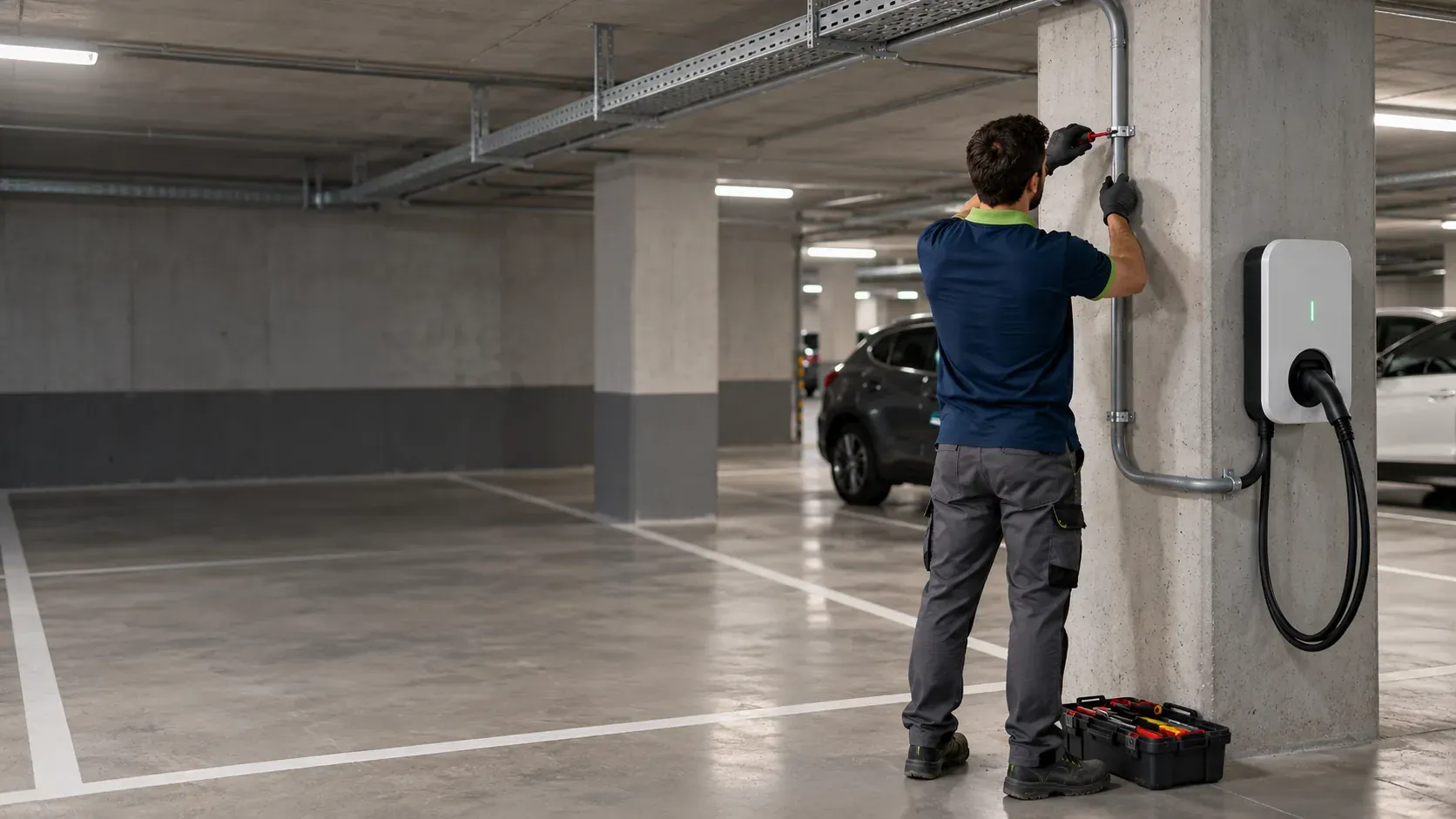
An EV charger in your communal garage space, without asking for permission
If you live in a flat and have a parking space in the building’s garage, you can install your own EV charging point. Spanish law is clear: you only have to notify the comunidad. It does not have to go to the owners’ meeting and you do not have to wait for the neighbours to vote. We take care of the technical side and the paperwork, and you only have to sign the letter we prepare.
This page is for spaces in shared garages under blocks of flats. If your home is a villa or townhouse with its own garage, the charger is fed from your house fuse board and the job is simpler: see home EV charger installation for houses.
The comunidad, explained for foreign owners
In Spain every block of flats is run by a comunidad de propietarios, the community of owners (a homeowners’ association, or HOA, in American English). It has a president, an owner elected each year, and usually a property administrator (administrador de fincas) who manages it day to day. The garage ceiling, the meter room and the walls are common elements. Many foreign owners assume they need a vote at the annual meeting before touching any of them. For an EV charger in your own space, they do not.
What the law says: article 17.5 of the Horizontal Property Act and the Supreme Court
Article 17.5 of the Horizontal Property Act (Ley de Propiedad Horizontal, LPH) states that installing a charging point for private use in an individual garage space only requires prior notice to the comunidad, and that the cost of the installation and the electricity are paid in full by the person concerned.
The remaining question was what happens when the cable has to run along the garage ceiling, which is a common element. The First Chamber of the Supreme Court settled it in its judgment of 1 December 2025, published in its press release of 12 December: even if the wiring runs wholly or partly through common elements or has to be fixed to them, the community’s authorisation is not needed, unless there is an unnecessary or disproportionate impact on those elements or harm to the other owners.
What the comunidad can and cannot ask for:
- It can ask for the installation to be done by a registered company, for conduits and fire compartments to be respected, for affected elements to be repaired and for the consumption not to come from the communal meter.
- It cannot impose a charger brand on you, force you to use its installer or charge you a fee for installing it.
The famous 30-day wait is not in the law. It is a prudent practice to leave a record and allow time for the comunidad to give you access to the meter room.
How we bring power from your meter to your space
The most common case is scheme 2 of ITC-BT-52: the line leaves your meter in the meter room and runs to your space, and the car is paid for on your home electricity bill. These are the steps:
- Technical visit. We locate the meter room, measure the real distance to your space, check your contracted power (potencia contratada) and see whether there are usable conduits or cable trays and where the fire compartments are.
- Origin of the line. We install a junction box with protection at the output of your meter, or start from your flat’s fuse board if it is closer.
- Route. Rigid flame-retardant conduit or a metal cable tray along the garage ceiling, following the common routes, with fire-stop sealing at every compartment crossing and avoiding other neighbours’ spaces.
- Protection at the space. A small board with a type C circuit breaker, a 30 mA type A RCD (or type B if the charger has no 6 mA DC detection) and a surge protector.
- Charger and load balancing. We fix the charger to the wall or pillar and fit a meter that tells it what your home is using, so it never exceeds your contracted power. If that power is too low, see increase your contracted power.
- Boletín and technical report, registration with the regional industry department and set-up in the manufacturer’s app.
When the space is very far from the meter, or the owner does not live in the building, the alternative is scheme 3: a new meter just for the space, connected in the meter room. It has a connection cost of 800 to 2,500 euros plus about 100 euros for the paperwork and a fixed charge of 8 to 12 euros a month for the power, but it lets you contract a tariff designed for the car. Remember that the space must be in the same building community as the meter it is fed from.
What our service includes
- Technical visit and a fixed written quote with the metres included.
- Letter notifying the comunidad with the technical details: space, scheme, route, charger, power and installer company.
- Dedicated line with halogen-free cable, conduit and sealing of compartment crossings.
- Protection board at the space and surge protector.
- 7.4 kW charger with dynamic load balancing, or the model you choose.
- Boletín and technical report registered with the Junta de Andalucía, documents that remain available for the garage’s periodic inspection if it has more than 25 spaces.
- Itemised invoice for the 15 % income tax deduction.
Price of an EV charger in a communal garage by distance
| Distance to the meter | Without pre-wiring (plus 21 % VAT) | With pre-wiring, conduit in place (plus 21 % VAT) |
|---|---|---|
| 10 metres | 1,700 euros (2,057 with VAT) | 1,250 euros (1,512.50 with VAT) |
| 20 metres | 1,800 euros (2,178 with VAT) | 1,350 euros (1,633.50 with VAT) |
| 40 metres | 1,900 euros (2,299 with VAT) | 1,450 euros (1,754.50 with VAT) |
| Other items | Guide price (plus 21 % VAT) | Total with VAT |
|---|---|---|
| General range in a communal garage | 1,200 to 2,200 euros | 1,452 to 2,662 euros |
| Separate meter for the space (scheme 3) | connection of 800 to 2,500 euros plus paperwork | 968 to 3,025 euros plus paperwork |
| Boletín and technical report | 80 to 150 euros, included in the price | included |
| Collective pre-wiring for the whole garage | 3,000 to 8,000 euros shared among neighbours | 3,630 to 9,680 euros shared |
Guide prices with a smart charger. The fixed price depends on the real distance, the cable size it requires and the floor or compartment crossings. All our rates are on the prices page.
New-build garages in Seville: Entrenúcleos, Palmas Altas and Sevilla Este
Since 16 December 2022, the Spanish Building Code (section HE 6, Royal Decree 450/2022) requires new residential buildings to have charging conduits in 100 % of the spaces and space reserved in the meter room. That is why many developments handed over between 2023 and 2026 have the conduit to your space, but no charger: each owner pays for and installs their own.
It is what we find every day in the garages of Entrenúcleos, in Dos Hermanas, where a dozen developers are handing over homes at the same time; in Palmas Altas and Isla Natura, with Metrovacesa buildings such as Residencial Etna or those of Palmas Altas Sur; and in Sevilla Este, in Jardines Hacienda del Rosario and the developments around FIBES. The public specifications of those developments do not detail the pre-wiring, so we check it in the garage or ask the administrator. If it is there, the charger costs a good deal less because no new conduit has to be laid. More on Entrenúcleos, Palmas Altas and Isla Natura and Sevilla Este.
If the comunidad has not been formed yet, the notice goes to the developer or to the management company running the building in the meantime, and you keep a copy. If you have just bought off-plan, our new-build section lists what is usually missing when you receive the keys.
When many neighbours want a charger
In a 40-space garage, 40 neighbours each with their own line means 40 cables along the ceiling and 40 connections in the meter room. That is what collective pre-wiring is for: a main line with a main meter and a load manager (scheme 1 of ITC-BT-52) to which each neighbour later connects their charger, paying only for their own section. It is approved by one third of the owners representing one third of the shares (article 17.1 of the LPH), those who vote in favour pay, and anyone who joins later pays their updated share. With a load manager, the regulation allows the expected load to be calculated with a simultaneity factor of 0.3, which protects the building’s incoming supply.
If the garage also needs its lighting, ventilation or periodic inspection brought up to date, see building maintenance.
Technical regulations we comply with
- ITC-BT-52 of the REBT (Royal Decree 1053/2014): dedicated circuit, individual 30 mA RCD protection of at least class A, surge protection, TN-S earthing system and a maximum voltage drop of 5 % from the meter to the charging point.
- Cable size by distance, as a usual rule for 7.4 kW: 6 mm2 up to 15 metres, 10 mm2 from 15 to 30 metres, 16 mm2 from 30 to 50 metres and 25 mm2 from 50 to 80 metres.
- Halogen-free cable and conduits suited to the garage, which is a space with fire risk.
- Installation certificate and technical report registered with the industry department. The distributor, e-distribución in Seville, needs it if the power has to be increased or a new meter connected.
Income tax deduction and grants in 2026
A parking space counts as property for the 15 % income tax (IRPF) deduction extended by Royal Decree-law 7/2026. If the space is yours and you do not use it for a business activity, you can deduct up to 600 euros (maximum base of 4,000 euros) for an installation completed before 31 December 2026, paid by non-cash means and carried out by a registered installer. The MOVES III programme closed applications on 31 December 2025. All charging cases are on the EV charger installation page.
EV charger price calculator
A guide based on 2026 market prices in Spain. You get a fixed quote once we have seen your garage.
Guide price with smart charger, installation, protection devices and boletín
1.300 €
With the 15 % income tax deduction (until 31 December 2026), it would cost you about 1.105 €.
Over 30 metres needs a thicker cable. For three phase we show the market range. Guide market prices, not an offer.
This service in your town
Where we do this most
Electrician in Dos Hermanas, Seville, Spain: the town, Montequinto and Entrenúcleos
Electrician in Sevilla Este, Seville, Spain: EV chargers and brand-new flats
Electrician in Nervión, Seville, Spain: 1960s and 1970s flats, rewiring and RCD faults
Electrician in Los Remedios, Seville, Spain: more power, fuse boards and earthing
Electrician in Triana, Seville, Spain: patio houses, riverside damp and bars
Electrician in Mairena del Aljarafe, Seville, Spain: flats, villas and new builds
Frequently asked questions
Do I need permission from the community to install an EV charger in Spain?
No. Article 17.5 of the Horizontal Property Act (Ley de Propiedad Horizontal) only requires prior notice to the comunidad when the charger goes in an individual parking space. There is no vote and no meeting. The Supreme Court confirmed it in its judgment of 1 December 2025, also when the cable runs through common areas, unless the impact is disproportionate.
Can the community block my EV charger?
Not for a private charger in your own space. The comunidad can require a registered installer, respect for the conduits and fire compartments, repair of anything affected and that the consumption does not come from the communal meter. It cannot impose a charger brand, force you to use its installer or charge you a fee for installing it.
How do I notify the comunidad?
In writing to the president or the property administrator (administrador de fincas), by burofax, recorded letter or email with acknowledgement of receipt. State the space, the registered installer, the charger model and power, the cable route and your commitment to pay for the installation and the electricity. We prepare the letter for you with the technical details.
How long do I have to wait after notifying?
The law sets no waiting period. The practice recommended by lawyers and installers is to allow about 30 days so the comunidad can give access to the meter room and the plans. After that, without a well-founded objection, the charger is installed. Those 30 days are a prudent custom, not a legal obligation.
Who pays for the installation and the electricity?
Always the owner who installs it: the work, the charger and the consumption are at their expense, as article 17.5 of the Horizontal Property Act says. The charger can never be connected to the garage's communal services meter, because that would mean using electricity paid for by all the neighbours.
Does my new-build garage already have pre-wiring?
If the building obtained its licence after 16 December 2022, the Building Code (CTE HE 6) requires conduits for charging in every space. We check it on the visit. With the conduit already in place we only need to pull the cable and install the board and charger, and the price drops to 1,250 to 1,450 euros plus VAT depending on the distance.
How much does an EV charger in a communal garage cost in Seville, Spain?
Between 1,200 and 2,200 euros plus 21 % VAT including charger, installation and boletín, depending on the distance to the meter and whether there is pre-wiring. As a reference, with a smart charger: at 10 metres, about 1,250 euros with pre-wiring and 1,700 without; at 40 metres, about 1,450 and 1,900 euros, all plus VAT.
What if my space is very far from the meter room?
The cable size is increased so the voltage drop stays within the 5 % allowed by the regulation, or a separate meter is installed for the space. From about 50 metres a separate meter usually pays off, and it also lets you contract a tariff designed for electric cars.
Can I install a charger in a rented parking space?
You need the consent of the owner of the space. A tenant cannot notify the comunidad in their own name. If the owner agrees, the owner signs the letter to the comunidad, and the installation can be done with a separate meter for the space so the consumption stays separate.
How long does the whole process take?
The physical work in the garage takes one or two days. Counting the notice to the comunidad, the technical visit, the installation and the registration of the boletín, the full process usually takes 6 to 8 weeks. If you notify the comunidad as soon as you decide, you save most of that time.
Related services
Communal EV charging backbone
A communal EV charging pre-installation in your building's garage in Seville, Spain sorts out the wiring once and for all: one backbone line, one charging board and a load manager, so each neighbour can later connect their own charger paying only their share and their own electricity.
Home EV charger for houses
EV charger installation in Seville, Spain for your villa or townhouse is a one-day job: a dedicated circuit from your fuse board, its own protection devices, a 7.4 to 22 kW wallbox and a boletín registered with the Junta de Andalucía. In 2026 you can still deduct 15 % in your Spanish income tax return.
EV charger grants and tax relief
EV charger grants in Seville, Spain come down to one in 2026: the 15 % income tax (IRPF) deduction, worth up to 600 euros, for installations completed before 31 December 2026. MOVES III closed in 2025 and the Auto+ programme does not cover chargers. Here is how to make the most of the deduction.
Dynamic load balancing
EV charger dynamic load balancing in Seville, Spain measures what your home is using in real time and adjusts the charger so you never exceed your contracted power (potencia contratada). You charge the car without paying for more power and without the power limiter cutting everything off when the oven or the air conditioning comes on.
Communal garage electrics
The communal garage electrical installation of a building in Seville, Spain covers much more than the lights: LED lighting with sensors, forced ventilation, carbon monoxide detection, emergency lighting, the automatic door and the infrastructure for charging electric cars. We renew it, maintain it and get it ready for the OCA inspection.
Increase contracted power
You need to increase your electricity power in Spain when the smart meter cuts everything off as soon as the air conditioning, the oven and the washing machine run together. We check what power your installation can take, upgrade the supply cable, main switch and fuse board if needed, and issue the boletín so the distributor approves the increase.
Related glossary terms
Need an electrician in Seville, Spain?
Call us or send a WhatsApp message with a photo of the job. You get a fixed quote before any work starts.