

EV chargers
Fleet EV charging in Seville, Spain: charging points for businesses, fleets and car parks
We install fleet EV charging in Seville, Spain: chargers for your company vehicles, for staff and for the customer car park, with user management by card, power sharing and consumption tracking per vehicle. We also handle the engineering project and the legalisation.
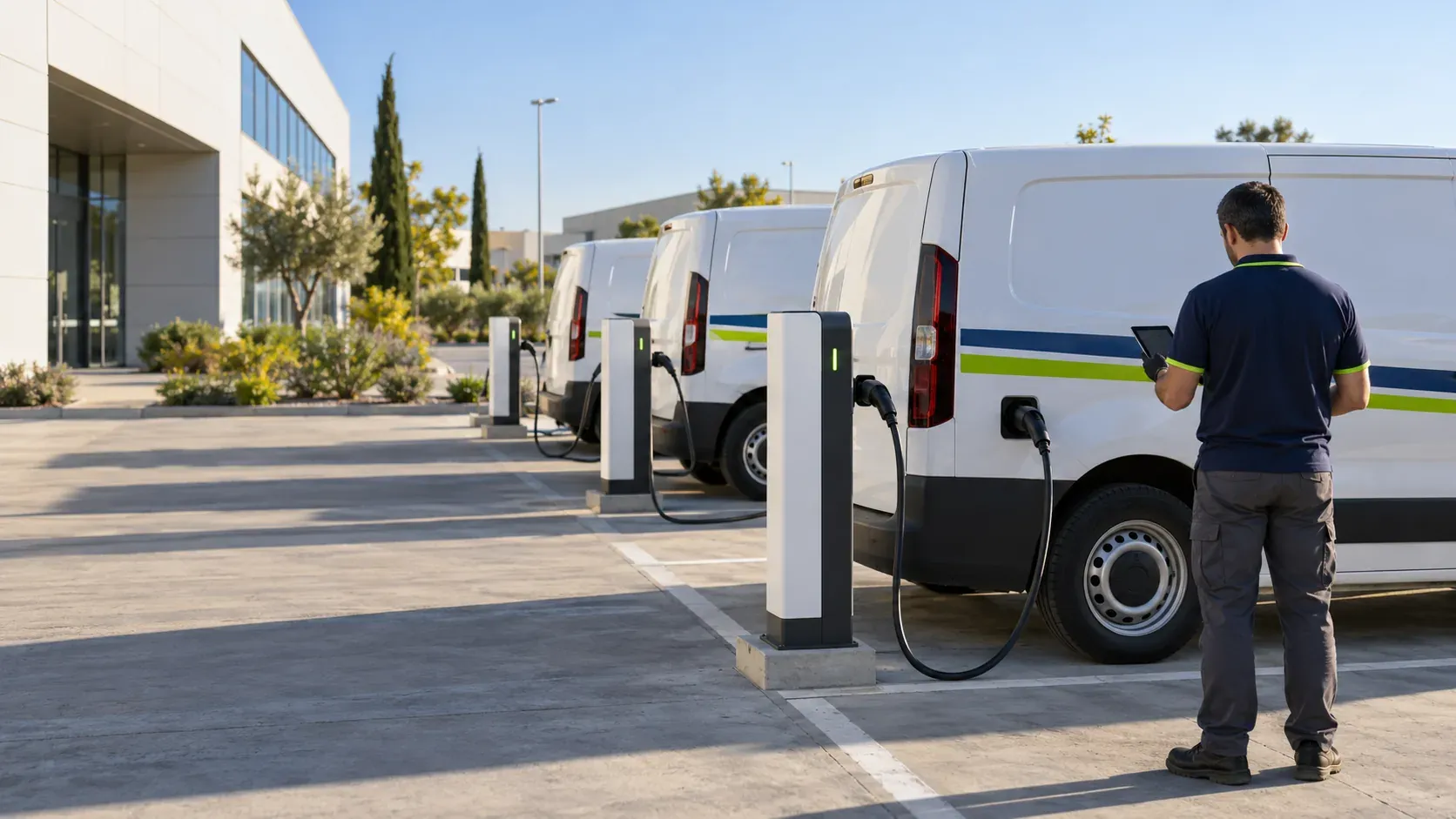
Fleet EV charging in Seville, Spain: what we solve
A charging point at work is not a home wallbox multiplied. The power of the warehouse or office has to be shared between several vehicles, you need to know who charges and how much, the car park has to meet Spanish regulations and, above a certain power, a project has to be submitted. We handle everything: study, installation, software set-up and legalisation. If your company has recently set up in Seville and you are not familiar with how Spanish electrical paperwork works, we explain each step as we go.
We work with three types of client:
- Companies with their own fleet: delivery vans, commercial vehicles, taxis or private hire vehicles that sleep at the depot and leave fully charged every morning.
- Companies with staff parking: offices and warehouses that want to offer charging to their employees, free or with the cost allocated.
- Car parks: rotating users, payment by energy and compliance with the compulsory minimum provision.
If your case is serving customers who park for an hour or two, see our page on EV charging for hotels and shops.
When it is compulsory
- Existing non-residential buildings with more than 20 spaces: one charging station for every 40 spaces or fraction since 1 January 2023.
- New non-residential buildings with more than 10 spaces: conduits to 20 % of the spaces and one station for every 40 spaces (Spanish Building Code section HE 6, licences from 16 December 2022).
- New car parks not attached to a building: at least one station for every 40 spaces.
There is no specific penalty regime for the 2023 obligation, but there is liability in an inspection and when applying for activity licences. We review your car park and tell you how many points you need.
How we design the installation
- Overnight charging at the depot: AC chargers of 7.4 to 22 kW, as many as there are vehicles, with dynamic sharing of the available power. Dynamic load balancing avoids having to enlarge the supply for each new vehicle.
- Rapid back-up charging: a DC charger (mode 4) for emergencies or high-mileage vehicles. These units start at 50 kW and usually require more power or even a transformer substation.
- User management: RFID cards per vehicle or per driver and an OCPP-compatible platform. OCPP is the open protocol that connects the charger to the software and lets you change operator without changing the hardware. We always specify units with OCPP 1.6J, upgradeable to 2.0.1.
- Wiring scheme: a backbone with a main meter (scheme 1) or circuits from the warehouse fuse board (scheme 4b), depending on the car park layout.
- Protection: a 30 mA type A RCD with 6 mA DC detection or a type B RCD at each point, a circuit breaker, surge protection and halogen-free cable.
Industrial estates around Seville
Warehouses on Seville’s industrial estates (polígonos) have a very favourable profile: three-phase supply, spare power at night and large roofs. We work in PISA (Mairena del Aljarafe), La Isla (Dos Hermanas), Calonge, Store, Carretera Amarilla, El Pino, Aeropuerto, Fridex (Alcalá de Guadaíra), La Negrilla, Navisur, Parque Empresarial Torneo and the PCT Cartuja technology park. Cartuja is also inside the Low Emission Zone, which restricts vehicles without an environmental badge from Monday to Friday, 07:00 to 19:00, with fines from 2026. For estate-wide projects, see also EV charging on industrial estates.
Our usual proposal is the warehouse, fleet and solar package: chargers with a load manager and solar panels for self-consumption on the roof, so the fleet charges during the day with its own energy. If you also need to upgrade the warehouse fuse board or lighting, we cover it under business and industry and shops and offices.
How we work
- Free study: number of vehicles, daily kilometres, schedules, contracted power and available space.
- Technical and financial proposal with the number of points, the power and the software.
- Project and site supervision if charging exceeds 50 kW, with the initial inspection by the inspection body.
- Installation in phases, without stopping the company’s activity.
- Set-up of users, cards and platform, and training for the fleet manager.
- Certificate, registration with the regional industry department and a maintenance plan if you want one.
Price and grants
Each installation is quoted as a project, because it depends on the number of points, the available power and the distance to the fuse board. As a reference, management software with an operator costs roughly 3 to 10 euros per point per month, plus 21 % VAT.
On grants, MOVES III for charging infrastructure closed on 31 December 2025. To renew vehicles, the companies and self-employed line of the Auto+ programme and MOVES Flotas remain active in 2026, with 9,000 euros per N1 van and 12,000 euros per N2 lorry (truck) when an old vehicle is scrapped. Corporate tax advantages are best confirmed with your adviser before deciding. Every service in this family is on the EV charger installation page.
Frequently asked questions
Is it compulsory for my company to have charging points?
If your building is not residential and has more than 20 parking spaces, it should have had one charging station for every 40 spaces or fraction since 1 January 2023 (Royal Decree-law 29/2021 and Law 7/2021). In new buildings, conduits must also be laid to 20 % of the spaces.
When is an engineer's project needed?
When the power of the charging infrastructure exceeds 50 kW. In that case there is also an initial inspection by an authorised inspection body (OCA) and periodic inspections every 5 years. Below that power, a technical design report (memoria técnica de diseño) and the installation certificate are enough.
What charger power does a fleet need?
For overnight charging at the depot, the usual choice is AC chargers of 7.4 to 22 kW, one per vehicle, with dynamic power sharing. If a vehicle needs to recover range quickly, a DC rapid charger is added. We size it from your daily kilometres and schedules in the free study.
Can I see how much each driver charges?
Yes. With OCPP-compatible chargers and RFID cards per vehicle or per driver, the management platform records every session: energy, time and user. That way you can allocate the cost to each vehicle or recharge employees who charge their own car.
Are there grants for businesses in 2026?
For the infrastructure, MOVES III closed on 31 December 2025. For vehicles, the Auto+ programme has a line for companies and the self-employed, and MOVES Flotas helps with vans and lorries (trucks) when an old vehicle is scrapped. Corporate tax advantages are best confirmed with your adviser.
Can charging be combined with solar panels on the warehouse?
Yes, and in Seville it is especially profitable because a fleet that works during the day can charge at the warehouse with the solar output of the roof. The chargers read the meter and use the surplus, and the load manager prevents you from exceeding your contracted power.
Related services
EV charging for hotels and shops
An EV charger for hotels, restaurants and shops in Seville, Spain attracts customers who drive electric cars: they park, spend and leave with a fuller battery. We install chargers with payment by app or card and OCPP management, and we help you meet the compulsory minimum number of charging points.
Dynamic load balancing
EV charger dynamic load balancing in Seville, Spain measures what your home is using in real time and adjusts the charger so you never exceed your contracted power (potencia contratada). You charge the car without paying for more power and without the power limiter cutting everything off when the oven or the air conditioning comes on.
Solar EV charging
A solar EV charger in Seville, Spain lets you charge your electric car with the energy your roof does not use. We install the wallbox with its meter so it charges only from solar surplus, or from surplus plus a minimum from the grid, and if you do not have panels yet, we carry out the complete installation.
EV charger in a communal garage
An EV charger in a communal garage in Spain only requires you to notify the comunidad (the homeowners' association): no vote, no permission. We run the line from your meter to your parking space in Seville, install the charger with its protection devices and register the boletín.
Shops and offices
An electrical contractor in Seville, Spain for shops and offices: fuse board, lighting, sockets, air conditioning lines, emergency lighting and boletín, with the electrical documents the opening licence requires. For shops, offices, clinics, academies and franchises, including international companies setting up in the city.
Solar panels for self-consumption
We install solar panels in Seville, Spain and the surrounding province on a turnkey basis: we study your consumption and your roof, fit panels, inverter and protection devices, and handle the legalisation and the compensation for your surplus energy. With Seville's sunshine, each kW installed saves an average of about 189 euros a year.
Need an electrician in Seville, Spain?
Call us or send a WhatsApp message with a photo of the job. You get a fixed quote before any work starts.