

EV chargers
Bidirectional V2G and V2H chargers in Seville, Spain: your car as your home battery
We install the circuit and the switchboard for a bidirectional V2G or V2H charger in Seville, Spain, the kind that lets your car battery power your home during a power cut or at night. V2H can already be installed with approved equipment; V2G, which exports to the grid, is still waiting for a specific payment scheme in Spain.
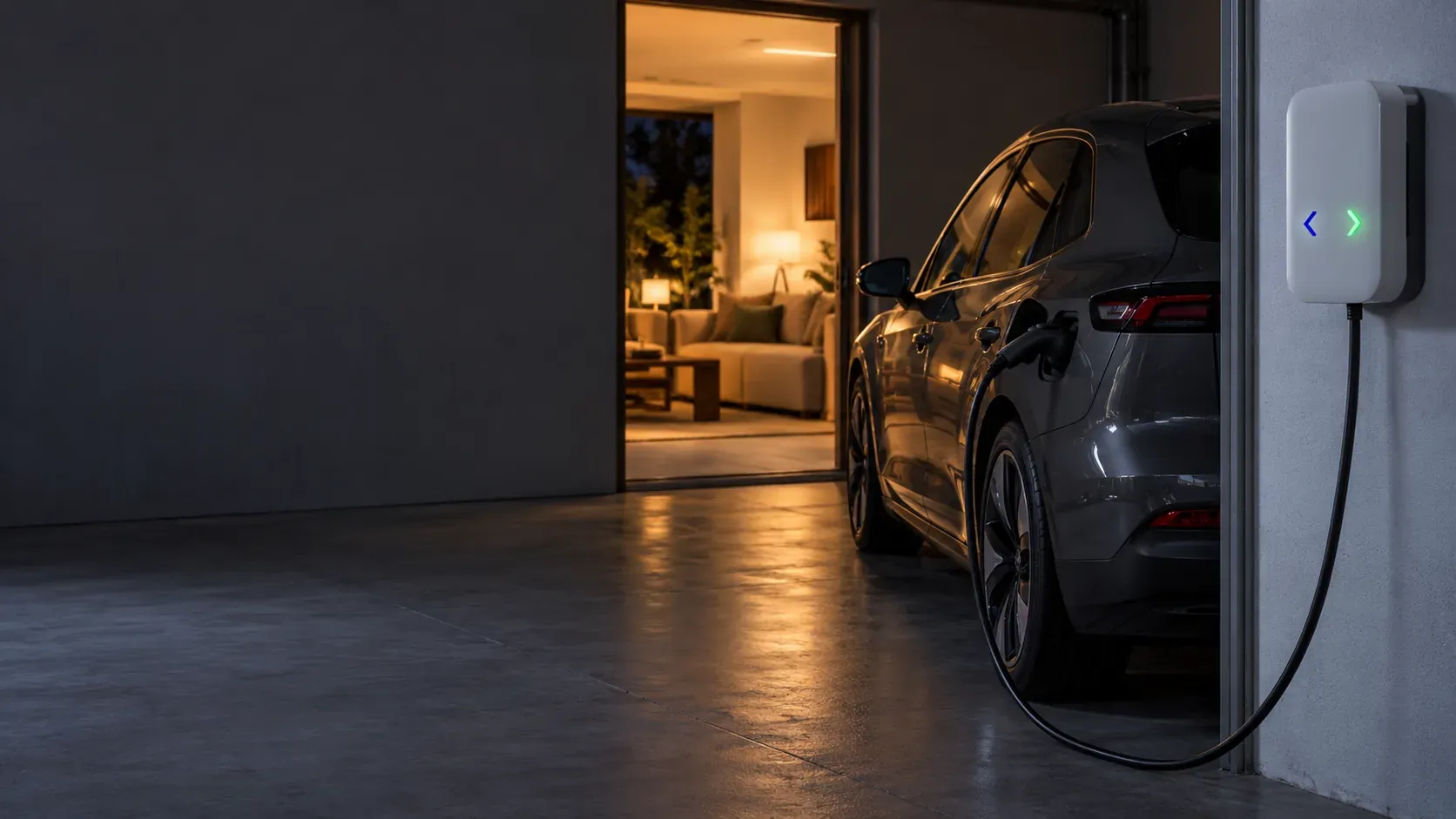
What a bidirectional V2G or V2H charger is
A normal charger only puts energy into the car. A bidirectional V2G or V2H charger can also take it out. There are two uses:
- V2H, vehicle to home. The car battery powers your house: during a power cut (outage in the US), during expensive hours or at night with the solar energy you stored during the day. It can already be installed today with approved equipment.
- V2G, vehicle to grid. The car exports energy to the distributor’s grid in exchange for payment. It is technically possible, but in Spain there is still no specific payment for it.
The difference in size is the key: an electric car battery holds many more kWh than a home battery, although it is only available while the car is parked and plugged in.
What you need
- A bidirectional charger. There are DC units with a CCS2 connector, such as the 11.5 kW Wallbox Quasar 2, and AC units for cars that support it.
- A compatible car, depending on model and version: Nissan Leaf with CHAdeMO, Kia EV6 and EV9, Hyundai Ioniq 5 and 6, Volkswagen ID with the 77 kWh battery, Cupra Born, Renault 5 on AC and some recent BYD models.
- A smart meter and, to get the most out of it, a tariff with different prices by time of day. The standard Spanish domestic tariff (2.0TD) already has peak, standard and off-peak bands (punta, llano and valle).
- A switchboard prepared to run isolated from the grid during a power cut, without sending voltage out to the street.
Where bidirectional charging stands in 2026
In July 2026 the European Commission published an Electrification Action Plan that includes a regulatory sandbox for V2G, and the standards for AC bidirectional charging are practically settled ahead of the 2027 deadlines. Germany is preparing its own regulation and already has commercial offers there with an annual bonus. In Spain, exporting to the grid falls under self-consumption (Royal Decree 244/2019) with no payment of its own for the car. That is why today we recommend V2H, and an installation ready for V2G.
Where a bidirectional V2G or V2H charger makes most sense in Seville
In a detached or semi-detached house with solar panels and its own garage: villas in the Aljarafe in Tomares, Mairena del Aljarafe or Bormujos, or the new houses in Entrenúcleos and Altos del Aire. The car charges from the panels during the day and the house draws on its battery in the evening, when the air conditioning demands more. If you do not have panels yet, you can start with solar panels or compare with a fixed solar battery.
Ready for the future
If you are installing a charger at your house now, we can size the circuit, the ITC-BT-52 protections (the Spanish EV charging regulation) and the switchboard for a bidirectional unit from the start, and choose an upgradable charger. The day you change car or the regulation arrives, the step will be swapping the unit, not opening walls again.
How we work
- We check the compatibility of your car and your current installation.
- We explain what you can do today (V2H or pre-installation) and what is not worth it yet.
- We design the switchboard and the isolation from the grid, with a fixed quote.
- We install, certify and register the installation with its boletín (electrical certificate) filed with the Junta de Andalucía, the regional government.
More options under EV charger installation.
Where we do this most
Electrician in Tomares, Seville, Spain: villas, pools, solar panels and EV chargers
Electrician in Mairena del Aljarafe, Seville, Spain: flats, villas and new builds
Electrician in Bormujos, Seville, Spain: townhouses, gardens and EV chargers
Electrician in Dos Hermanas, Seville, Spain: the town, Montequinto and Entrenúcleos
Electrician in the Aljarafe, Seville, Spain: Castilleja, Gines, Espartinas and more
Frequently asked questions
What is the difference between V2G and V2H?
With V2H (vehicle to home) the energy in the car battery powers your house and stays there. With V2G (vehicle to grid) the energy is exported to the distributor's grid so you get paid for it. Both need a bidirectional charger and a compatible car, but in Spain today only V2H is of practical use in a home.
Does my car support bidirectional charging?
It depends on the model and version. Compatible cars include the Nissan Leaf with CHAdeMO, the Kia EV6 and EV9, the Hyundai Ioniq 5 and 6, Volkswagen ID models with the 77 kWh battery, the Cupra Born, the Renault 5 on AC and some recent BYD models. We check your car's specifications before recommending any equipment.
Will I get paid for exporting energy from my car to the grid in Spain?
Not yet. In Spain, exporting to the grid falls under the self-consumption rules of Royal Decree 244/2019, and there is no specific payment for V2G. Europe is getting ready: in July 2026 the European Commission published a plan with a regulatory sandbox for V2G, and Germany already has commercial offers.
Can the car power my house during a power cut?
Yes, with a V2H system designed for it. As well as the bidirectional charger, the installation must isolate the home from the grid while the supply is down, so no voltage is sent out to the street, and the switchboard has to be prepared for that mode. We design it and explain which circuits will stay powered.
Is it worth installing now?
If you have a compatible car and solar panels, V2H already lets you use at night the energy the car stored during the day. If not, the sensible thing is to leave the installation ready: a circuit and switchboard sized for a bidirectional unit and an upgradable charger, so the work does not have to be redone later.
Does it work with my solar panels?
That is where it makes most sense. You charge the car during the day with the surplus from your panels, and at night the house uses that energy from the car battery instead of buying it. In Seville, with around 3,000 hours of sunshine a year, combining solar and an electric car is especially favourable.
Related services
Home EV charger for houses
EV charger installation in Seville, Spain for your villa or townhouse is a one-day job: a dedicated circuit from your fuse board, its own protection devices, a 7.4 to 22 kW wallbox and a boletín registered with the Junta de Andalucía. In 2026 you can still deduct 15 % in your Spanish income tax return.
EV charger in a communal garage
An EV charger in a communal garage in Spain only requires you to notify the comunidad (the homeowners' association): no vote, no permission. We run the line from your meter to your parking space in Seville, install the charger with its protection devices and register the boletín.
Solar EV charging
A solar EV charger in Seville, Spain lets you charge your electric car with the energy your roof does not use. We install the wallbox with its meter so it charges only from solar surplus, or from surplus plus a minimum from the grid, and if you do not have panels yet, we carry out the complete installation.
Dynamic load balancing
EV charger dynamic load balancing in Seville, Spain measures what your home is using in real time and adjusts the charger so you never exceed your contracted power (potencia contratada). You charge the car without paying for more power and without the power limiter cutting everything off when the oven or the air conditioning comes on.
Solar batteries
We install solar batteries in Seville, Spain, lithium units in new installations or added to panels you already have, so the energy left over at midday can be used in the evening and at night. First we use your real consumption to work out whether it pays off, how much capacity you need and which inverter is required.
Solar panels for self-consumption
We install solar panels in Seville, Spain and the surrounding province on a turnkey basis: we study your consumption and your roof, fit panels, inverter and protection devices, and handle the legalisation and the compensation for your surplus energy. With Seville's sunshine, each kW installed saves an average of about 189 euros a year.
Need an electrician in Seville, Spain?
Call us or send a WhatsApp message with a photo of the job. You get a fixed quote before any work starts.