
24-hour emergencies
Electric shocks from taps and appliances: earthing check in Seville, Spain
If you get electric shocks from taps (faucets), the shower, the washing machine or the fridge, a metal part is live and the current is not being carried to earth. That is a real risk of electrocution. In Seville, Spain we check the earthing (grounding), the protective conductors and the insulation of your appliances to find the fault and remove it.
Why a tap or an appliance gives you a shock
In a correct installation, every metal part that could become live by accident (the casing of the washing machine, the water heater, the oven or the bathroom pipes) is connected to the earth by the yellow and green wire. If an internal cable touches the casing, the current takes that path, the RCD detects the leakage and cuts the power.
When you feel electric shocks from taps or appliances, one of those two things is failing: there is a leakage in an appliance or a cable, and the earth is not carrying it where it should. The current then looks for another path to earth, and that path is you.
That is what sets shocks apart from other faults: here the risk is directly to people, especially in bathrooms and kitchens, where skin is wet and contact with water and the floor is greater.
Shocks, a tripping RCD or a dead socket?
These three symptoms are related but they are not the same. A shock means a leakage that nothing is stopping. An RCD (diferencial, GFCI in the US) that trips and will not stay up means a leakage that the protection is detecting, which is a good sign: see RCD keeps tripping. And sockets with no power are a different fault altogether, covered in sockets not working. If you get a shock and the RCD has not tripped, treat it as the most urgent of the three.
Most frequent causes
- A home with no earthing. Very common in older flats. The sockets have the side clips, but there is no earth behind them.
- A broken or loose earth. The protective conductor has come loose in a box or in the fuse board, or was cut during a renovation.
- An electric water heater with a damaged element. A typical cause of shocks in the shower and the bathroom tap, because the water heater (termo) is connected directly to the water pipes.
- An appliance with a leakage. A washing machine, dishwasher, fridge or oven with internal damp or a worn component.
- Broken bathroom equipotential bonding. The pipes and metal parts of the bathroom must be joined together so there are no voltage differences between them. If that bond is missing, voltage can appear between the tap and the drain.
- An RCD that does not act. If the leakage exists and the RCD does not trip, it may be faulty.
What to do right now
- Do not touch the tap or the appliance that gave you the shock again.
- Unplug the suspect appliance or, if you do not know which it is, switch off its circuit breaker in the fuse board.
- If the shock is in the shower, switch off the water heater at its breaker and do not shower until it has been checked.
- Press the RCD test button (marked with a T). If it does not trip, call us: your protection is not working.
How we check it
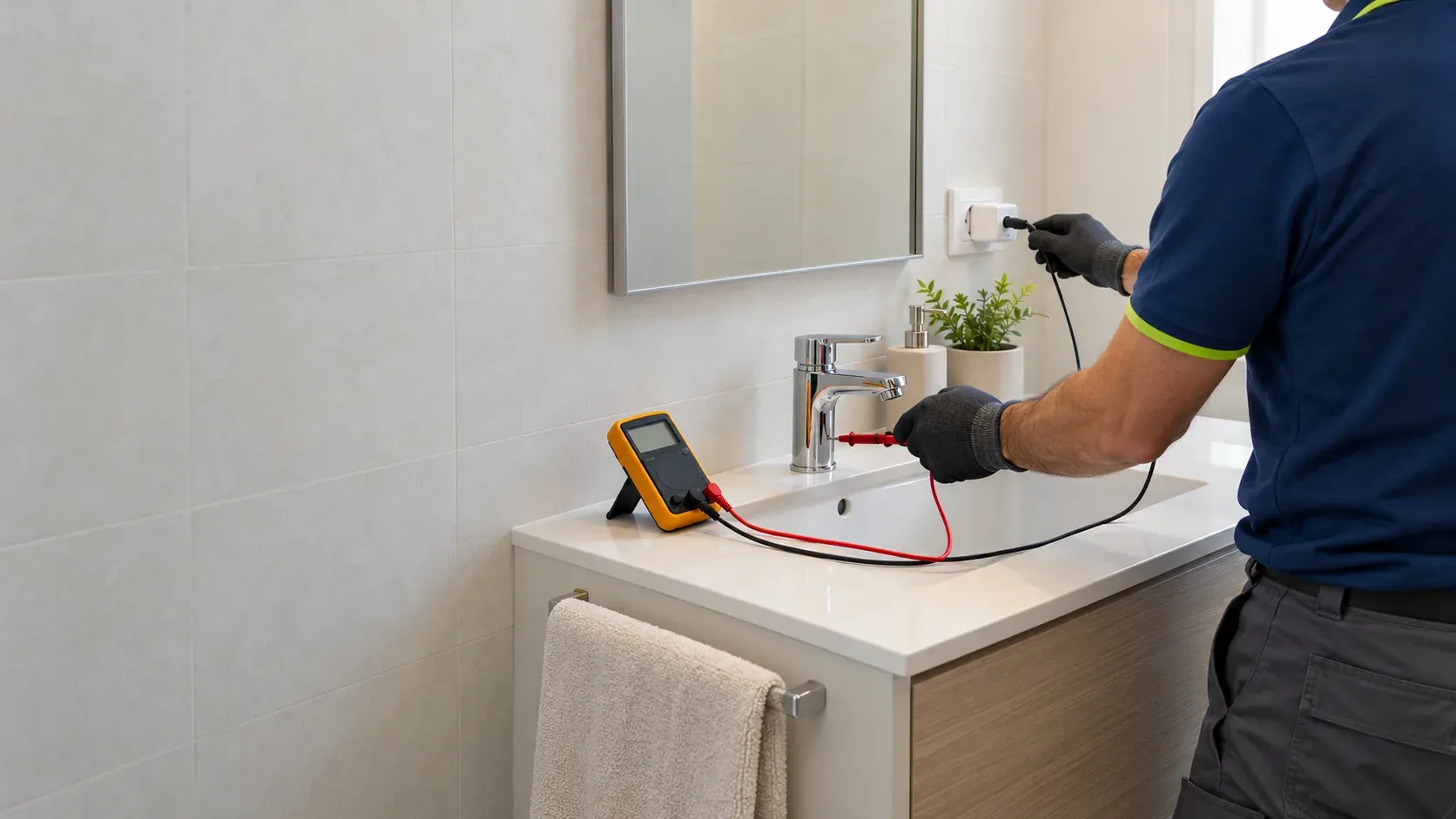
- We measure the voltage on the tap, the pipes and the casings to confirm the problem and its size.
- We check the continuity of the protective conductors from every socket and appliance back to the fuse board.
- We measure the earthing of the building or the home to know whether it exists and whether its value is adequate.
- We measure the insulation of the suspect appliances, starting with the water heater and the washing machine.
- We test the RCD with a tester that measures its trip time and trip current.
- We repair: we reconnect the earth, redo the equipotential bonding, isolate the leaking appliance or install new earthing.
The regulations that apply are ITC-BT-18 (earthing installations), ITC-BT-24 (protection against direct and indirect contact) and ITC-BT-27 (rooms containing a bath or shower).
Flats without earthing in Seville
In the 1960s and 1970s blocks of Los Remedios, Nervión or La Macarena, many homes were built without earthing or with an earth that never reached the sockets. The typical case: an old electric water heater, its element starting to fail, in a flat with no earth. The leakage trips nothing, and the first warning is a tingle when you turn off the shower tap. In these cases we replace or repair the water heater, but the real solution is to install earthing and connect the sockets and appliances to it. If the installation also has old cables and few circuits, it makes sense to consider rewiring the apartment. A full electrical inspection tells you where you stand.
Guide prices
| Job | Guide price (plus 21 % VAT) | Total with VAT |
|---|---|---|
| Check of earthing and appliance insulation | 70 to 100 euros | 84.70 to 121 euros |
| Installing or improving the earthing | from 250 euros, depending on access | from 302.50 euros |
| Earthed socket for a washing machine or dishwasher | 40 to 120 euros | 48.40 to 145.20 euros |
These are guide prices. If the fault is in an appliance, we tell you so you can decide whether to repair or replace it, and if you need a new line for a kitchen or air conditioning appliance, see air conditioning and appliances. If you get a shock, call us at any hour through our 24-hour emergency electrician service.
Frequently asked questions
Why does the shower tap give me a shock?
Because a metal part of the water installation has become live: an electric water heater (termo) with a damaged element, a cable touching a pipe or a damp socket box. If the home also has no earthing, or the bathroom equipotential bonding is broken, that voltage reaches the tap. Do not use the shower until it has been checked.
Why does my washing machine give me a shock?
It is usually a leakage in the appliance itself, from damp or a worn heating element, combined with a socket with no earth or a loose earth wire. With proper earthing, that leakage would trip the RCD instead of passing through your hand. Both things need checking: the appliance and the earthing.
Does my home have earthing? How can I tell?
Look at your sockets: if they have the two metal clips on the sides (the standard Schuko socket), they are designed for earth, but that does not guarantee the wire is connected. Only a measurement confirms it. In many flats from the 1960s and 1970s there are sockets with clips that were never connected to a real earth.
Is earthing compulsory in a home in Spain?
Yes in new installations and in renovations, under ITC-BT-18 and ITC-BT-26 of the Spanish Low Voltage Electrotechnical Regulation. Older homes that never had it still exist, but without earthing the RCD cannot protect you properly from a leakage in an appliance. It is the most important safety upgrade in those homes.
How much does the check cost in Seville, Spain?
Checking the earthing, the protective conductors and the insulation of the appliances costs 70 to 100 euros plus 21 % VAT (84.70 to 121 euros in total). If earthing has to be installed or improved, the price depends on access and the building, and you get a fixed quote before we start.
Why do I get a spark when I touch the fridge?
If it is a small static discharge from your clothes or the floor, it is not serious. If you feel a tingle or a shock every time you touch it, there is a leakage in the appliance that is not going to earth. Unplug it and have it measured before you use it again.
Related services
Earthing
Earthing (grounding in the US, toma de tierra in Spain) is what allows your RCD to protect you from an electric shock. In Seville, Spain we carry out earthing installation and testing in flats and houses: earth rods or buried conductor, main earth line, connection of every circuit and a resistance measurement to confirm it works.
RCD keeps tripping
If your RCD keeps tripping and will not stay up, there is a current leaking to earth somewhere in a circuit or an appliance. We locate it with an insulation tester, repair it and check that your RCD (GFCI) protects you as it should.
Rewiring old apartments
Rewiring an apartment in Seville, Spain is the answer when the installation is more than 25 or 30 years old: fabric or dried-out cables, no earthing, a single RCD and a supply that cannot run the air conditioning and the induction hob at once. We renew cables, conduits, fuse board, earthing and fittings and hand you the boletín.
Electrical inspection
A home electrical safety inspection in Seville, Spain tells you, with measurements rather than guesswork, what state your home is in: earthing, cable insulation, RCDs, fuse board and cable sizes. You get a report with what is fine, what is worth improving and what is urgent. Ideal before buying, renting or renovating.
Induction hob circuit
The induction hob electrical requirements in Spain are clear: to fit an induction hob (cooktop) in Seville properly, the electrician runs a dedicated 6 mm² line from the fuse board, with its own 25 or 32 A circuit breaker and a connection box behind the unit. That way the hob works at full power and the electricity does not trip when it coincides with the oven.
Need an electrician in Seville, Spain?
Call us or send a WhatsApp message with a photo of the job. You get a fixed quote before any work starts.