
24-hour emergencies
RCD keeps tripping at home? Electrician in Seville, Spain to find the leakage
If your RCD keeps tripping and will not stay up, there is a current leaking to earth somewhere in a circuit or an appliance. We locate it with an insulation tester, repair it and check that your RCD (GFCI) protects you as it should.
What it means when the RCD keeps tripping
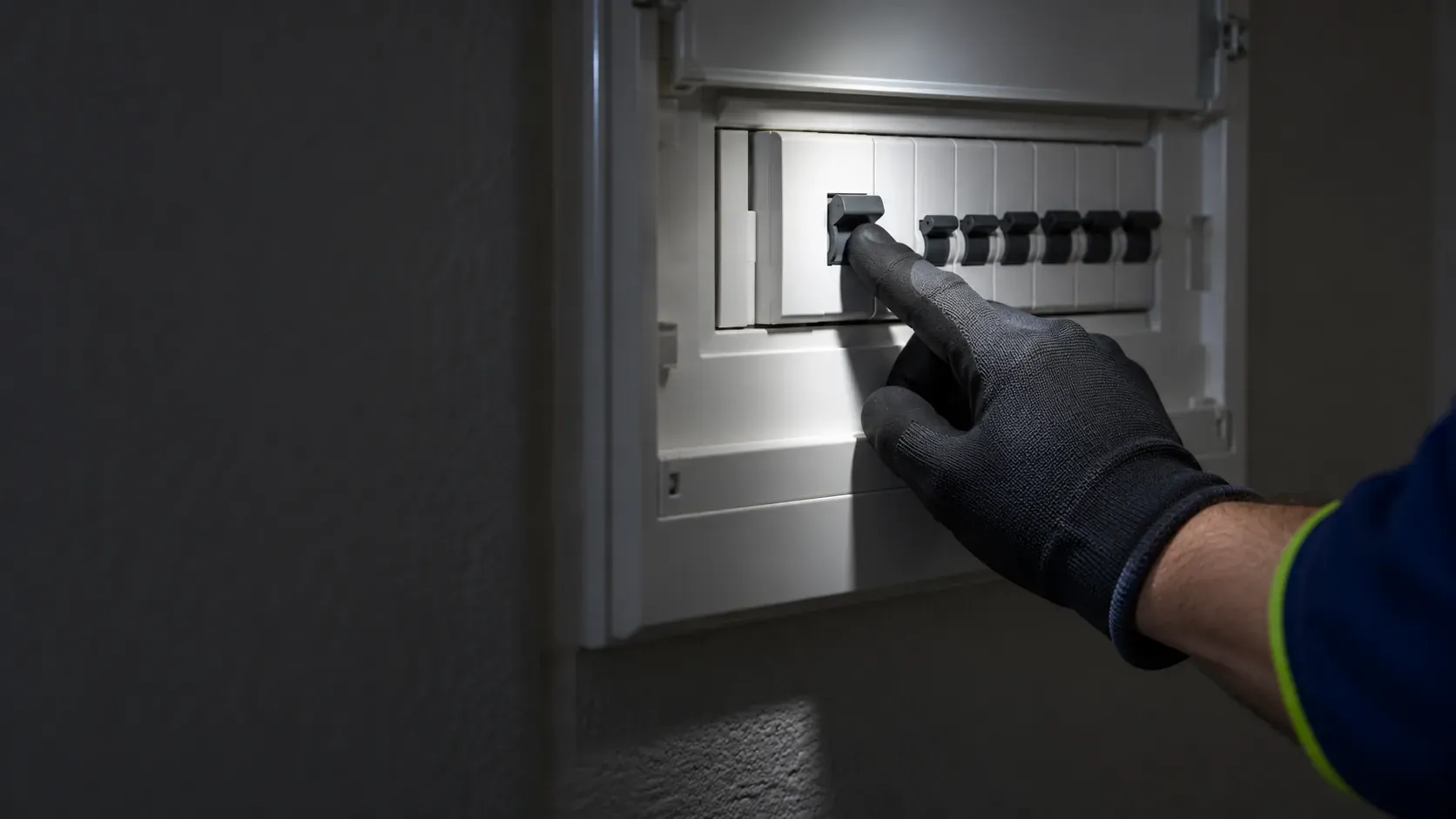
The RCD (residual current device, called a GFCI or ground-fault breaker in the US, and diferencial in Spain) checks that all the current going into your installation comes back the same way. When part of it escapes to earth, through a faulty appliance, a bare cable or water in a box, it detects the difference and cuts the power in a fraction of a second. Homes in Spain use high-sensitivity 30 mA RCDs, because that current can already be dangerous for a person. That is why the Spanish Low Voltage Electrotechnical Regulation (ITC-BT-25) requires them on every circuit in a home.
So the RCD tripping is not the fault: it is the warning. The fault is the leakage, and it has to be found. If you have just moved to Seville and are used to a consumer unit with one RCD per row of breakers, the logic is exactly the same; only the names change.
Is it really the RCD? Check this first
Many foreign residents say “the trip switch keeps going” when in fact three different things can cut the power:
- The RCD (diferencial). It has a TEST button and its lever drops when current leaks to earth. This is the case this page is about.
- A circuit breaker (magnetotérmico, MCB). One lever drops on its own, usually the kitchen or the air conditioning, because of an overload or a short circuit.
- The power limiter (ICP) in the smart meter. Nothing moves in your fuse board, the whole home goes dark and the power comes back after a few seconds. That is not a fault but your contracted power (potencia contratada) being exceeded, and the solution is to spread your consumption or increase your contracted power.
If it is the RCD, read on.
Most common causes of an earth leakage
- A faulty appliance. Water heaters, washing machines, dishwashers and ovens are the first suspects, because they combine water and heating elements.
- Damp in the installation. Terrace or patio sockets, garden lights, junction boxes with water ingress or the motor of an awning or a roller blind.
- Damaged cables. A nail or a drill that has hit a conduit, cables chewed by rodents or old, dried-out insulation, typical of installations over 30 years old.
- Many small leakages added together. In homes with lots of electronic equipment (computers, TVs, chargers, inverter air conditioning), the tiny leakage of each appliance adds up and can trip a sensitive RCD.
- A defective RCD. Less frequent, but it happens with old devices or with ones that have suffered a power surge.
How we find the leakage
- We isolate the circuits from the fuse board to find out which one has the problem.
- We measure the insulation with an insulation resistance tester (megger), circuit by circuit, to know whether the leakage is in the cable or in an appliance.
- We check the earthing, because without proper earthing (grounding) the RCD cannot protect you properly.
- We test the RCD with a tester that measures its trip time and trip current.
- We repair the faulty element and measure again to leave everything within the values set by the regulations.
When it is worth checking the whole installation
If the RCD trips frequently and the home is over 30 years old, the cause is usually the general ageing of the installation, not one specific appliance. We see it often in the 1960s and 1970s flats of Nervión, Los Remedios or La Macarena: cables with cracked insulation, no earthing and few circuits. In those cases the most cost-effective option is to rewire the apartment or, at least, to fit a new fuse board with several RCDs that share out the circuits, so that one leakage does not leave the whole home in the dark. You can read more about the typical buildings of Nervión and Los Remedios.
Typical leakages by type of home
Not every home fails in the same way, and knowing where to look shortens the diagnosis a lot:
- Flats from the 1960s to the 1980s. The usual culprit is ageing wiring: fabric or dried-out plastic insulation, junction boxes with joints wrapped in insulating tape and conduits that have collected damp for decades. Here the leakage is usually spread out and appears mainly in summer, with the air conditioning running flat out.
- New-build homes. In Sevilla Este, Palmas Altas or Entrenúcleos the wiring is new, so the leakage almost always comes from a newly installed appliance or a badly connected fitting during the move, such as a light hung without the terminals properly covered.
- Villas and townhouses in the Aljarafe. Outdoor damp is the main factor: buried garden lights, the pool pump, automatic irrigation or a barbecue socket without the right IP rating. See our page on the Aljarafe north.
- Shops and hospitality. Cold rooms, commercial dishwashers and fryers collect grease and damp, and an RCD that trips at peak time forces you to close. Here it is worth splitting the kitchen circuits across several RCDs.
Types of RCD and upgrades we can suggest
- Standard 30 mA RCD, type AC or A. This is what most fuse boards have. Type A also detects leakages with a pulsating DC component, common in inverter washing machines, induction hobs and electronic power supplies, and it is the recommended choice today.
- Super-immunised RCD. It keeps the 30 mA protection but withstands the surges and harmonics of modern electronics better, so it does not trip for no reason during a storm or when several appliances start at once. It is the solution when the RCD trips and no real leakage can be found.
- Automatic recloser. A small motor pushes the RCD back up when it has tripped because of a passing disturbance, after checking that there is no leakage. Very useful in second homes, houses with a fridge and freezer and businesses with cold rooms, especially if you spend part of the year away from Spain.
- Several RCDs in the fuse board. Splitting the circuits between two or three RCDs means a leakage on the terrace does not also switch off the fridge and the router. It is a cheap upgrade that avoids many emergency call-outs.
Guide prices in Seville
| Job | Guide price (plus 21 % VAT) | Total with VAT |
|---|---|---|
| Diagnosis and location of the leakage | from 70 euros | from 84.70 euros |
| Replacing a standard 40 A, 30 mA RCD | 80 to 150 euros | 96.80 to 181.50 euros |
| Super-immunised RCD, fitted | 120 to 220 euros | 145.20 to 266.20 euros |
| Automatic recloser | 180 to 350 euros | 217.80 to 423.50 euros |
| Replacing a damaged length of cable | depending on metres and access | quoted beforehand |
Before repairing we give you the fixed price of the specific job, and if the cause is an appliance we tell you so you can decide whether it is worth repairing. More rates on our prices page.
What you can do before calling us
- Unplug the appliances in the area where the power went off.
- Switch off all the circuit breakers in the fuse board and push the RCD up.
- Switch the circuit breakers back on one by one. The one that trips the RCD is the affected circuit.
- Leave that circuit off and use the rest of the home normally until we arrive.
If there is a burning smell, smoke or heat in a socket, do not run any tests: switch off the main switch and call our 24-hour emergency electrician. And if the RCD trips even with all the circuit breakers off, the leakage is before them, in the fuse board itself or in the cable that feeds it, and it must not be touched without a professional.
Where we do this most
Electrician in Nervión, Seville, Spain: 1960s and 1970s flats, rewiring and RCD faults
Electrician in Los Remedios, Seville, Spain: more power, fuse boards and earthing
Electrician in Triana, Seville, Spain: patio houses, riverside damp and bars
Electrician in Sevilla Este, Seville, Spain: EV chargers and brand-new flats
Electrician in Dos Hermanas, Seville, Spain: the town, Montequinto and Entrenúcleos
Electrician in Mairena del Aljarafe, Seville, Spain: flats, villas and new builds
Frequently asked questions
Why does my RCD trip and not go back up?
Because the leakage is still there when you try to reset it. It is usually a faulty appliance, damp in a box or an outdoor socket, or a cable with damaged insulation. As long as the leakage exists, the RCD will trip again, and that is exactly what it should do. Forcing it up repeatedly does not solve anything.
Can I find the faulty circuit myself?
You can do a first test: switch off all the circuit breakers, push the RCD up and switch the breakers on one at a time. The one that trips it is the circuit with the leakage. Then unplug the appliances on that circuit. If it still trips with nothing plugged in, the leakage is in the wiring and an electrician should check it.
Why does my RCD trip when it rains?
It is very common in Seville with the first autumn rains. Water gets into terrace sockets, garden lights, junction boxes or an awning motor and causes a leakage to earth. It is fixed by sealing or replacing the affected item with one that has the right IP rating (degree of protection against water) for its location.
My water heater (termo) or air conditioner trips the RCD. Why?
Electric water heaters, washing machines, dishwashers and ovens are the first suspects because they combine water and heating elements. Inverter air conditioners and other electronics each leak a tiny current, and in summer these small leakages add up until a sensitive RCD trips. We measure each circuit to tell an appliance fault from an overloaded RCD.
What is the difference between the RCD and the circuit breakers?
The RCD (diferencial, called GFCI in the US) trips when current leaks to earth and protects people from electric shock. The circuit breakers or MCBs (magnetotérmicos) trip on overload or short circuit and protect the cables. If the power goes off and nothing in your fuse board has moved, it may be the power limiter in the smart meter instead.
Do I need to replace the RCD?
Only if it is faulty: if it does not trip when you press the TEST button, if it trips with no leakage measured or if it is very old. In homes with lots of electronic equipment a super-immunised RCD may be worth it, because it avoids tripping caused by electrical disturbances without losing protection.
How much does it cost to fix an RCD that keeps tripping in Seville, Spain?
Diagnosis starts at 70 euros plus 21 % VAT in Seville city. Replacing a standard 40 A, 30 mA RCD costs around 80 to 150 euros plus VAT, fitted. If the leakage is in a cable, the price depends on the length that has to be replaced, and you get the fixed price before we start.
The RCD trips even with every circuit breaker switched off. What does that mean?
It means the leakage is before the circuit breakers: in the fuse board itself or in the cable that feeds it from the meter. That part should not be handled by anyone who is not a professional. Leave the main switch off if it is safe to do so and call an electrician to measure it.
Related services
24-hour emergency electrician
An emergency electrician in Seville, Spain for when the power goes off, the RCD trips, there is a burning smell or a socket sparks. We come out at any hour, find the fault, give you the price before repairing anything and leave the installation safe.
Electric shocks from taps
If you get electric shocks from taps (faucets), the shower, the washing machine or the fridge, a metal part is live and the current is not being carried to earth. That is a real risk of electrocution. In Seville, Spain we check the earthing (grounding), the protective conductors and the insulation of your appliances to find the fault and remove it.
MCB keeps tripping
If your MCB keeps tripping when you switch on the oven, the air conditioning or the washing machine, that circuit is overloaded or has a fault. We check the line, spread the loads or replace the circuit breaker (magnetotérmico) so your kitchen or living room stops losing power.
Fuse board replacement
A consumer unit replacement in Seville, Spain is the upgrade that adds the most safety without building work: main switch, several RCDs, one breaker per circuit and surge protection. We replace your old fuse box, or a board with a single RCD, with a new fuse board (breaker panel) sized for your power and your circuits.
Earthing
Earthing (grounding in the US, toma de tierra in Spain) is what allows your RCD to protect you from an electric shock. In Seville, Spain we carry out earthing installation and testing in flats and houses: earth rods or buried conductor, main earth line, connection of every circuit and a resistance measurement to confirm it works.
Need an electrician in Seville, Spain?
Call us or send a WhatsApp message with a photo of the job. You get a fixed quote before any work starts.