

Electrical safety
Surge protection in Seville, Spain: transient and permanent overvoltage
Surge protection in your fuse board in Seville, Spain is the cheapest way to save the fridge, TV, router, boiler and induction hob from lightning, storms and voltage surges. We fit protectors against transient and permanent overvoltage, or combined units, in homes, business premises, EV chargers and solar installations.
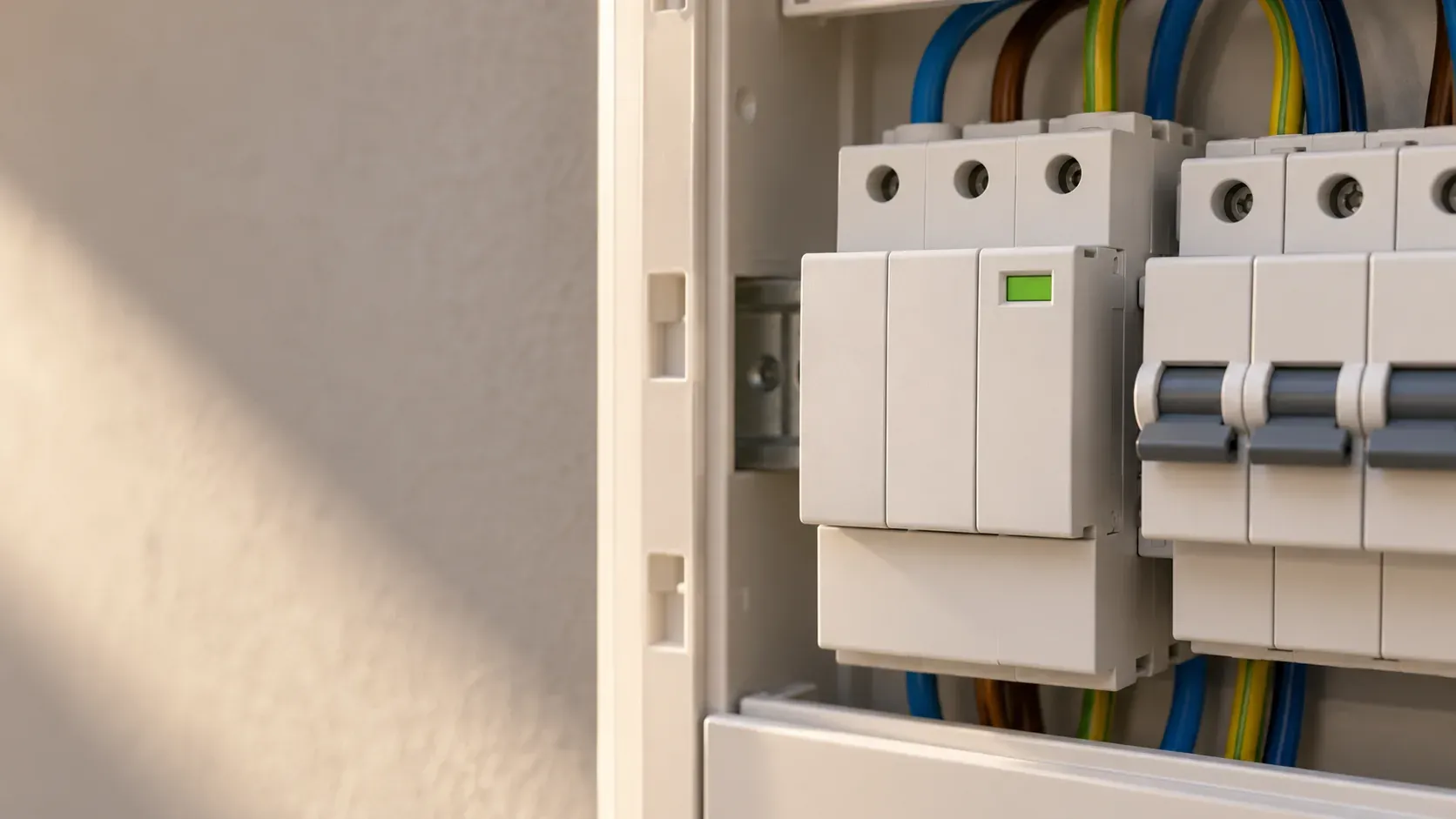
Surge protection in Seville: what it protects and why it is worth it
Late summer and autumn storms, grid cuts and reconnections, and faults on the supply cable cause voltage surges that burn out routers, TVs, induction hobs (cooktops), computers and the electronics of boilers, air conditioners and appliances. A surge protector fitted in the fuse board (consumer unit, or breaker panel in American English) diverts or cuts those surges before they reach your appliances, and it costs far less than any of them.
We install surge protection in homes, shops and businesses in Seville, Spain, and include it as standard in the EV chargers and solar installations we fit.
Two kinds of overvoltage, two kinds of protection
- Transient overvoltage. Very short, very high spikes from nearby lightning or switching on the grid. The protector diverts them to earth in a fraction of a second.
- Permanent overvoltage. The voltage stays high for seconds or minutes, for example when the neutral of the supply cable breaks and some homes receive far more than normal. The protector detects the rise and cuts the supply until it returns to normal.
In a home the most common choice is a combined protector, which covers both cases in one unit. Both terms are explained in our glossary.
What the installation includes
- Check of the fuse board to see whether there is room and how it is protected.
- Measurement of the earthing, essential for a transient protector to work.
- Choice of protector according to the supply (single-phase or three-phase) and what you want to protect.
- Fitting in the board, at the entry to the installation, with its associated protection.
- Check of the status indicator and an explanation of how to read it.
If the board has no space or is very old, the sensible option may be a fuse board replacement with the protector built in. And if the home has no earthing, we start there.
When it is compulsory and when it is recommended
- New installations: ITC-BT-23 requires it in the cases the regulation sets.
- EV charging points: compulsory under ITC-BT-52.
- Solar installations: required in self-consumption installations (Royal Decree 244/2019).
- Existing homes: not always compulsory, but highly recommended, especially in detached houses, storm-exposed areas and homes with a lot of electronics.
Surge protectors follow standard UNE-EN 61643.
Protecting solar panels and the EV charger
Solar panels and car chargers are expensive, highly exposed and full of sensitive electronics. Besides the protector in the home’s board, they have their own protection:
- Solar: surge arresters and direct-current protection on the panel side, before the inverter, under ITC-BT-40 and UNE-HD 60364-7-712.
- EV charging point: a surge protector and a type A RCD with DC detection or a type B RCD, under ITC-BT-52.
This protection is included in the solar panels and the home EV charger for houses that we install.
If the storm has already passed
If a storm has left you without power, with an RCD that will not reset or with burnt-out appliances, the first step is to check the installation and see what has been damaged. We use that visit to fit the protector so it does not happen again.
Surge protectors in Aljarafe villas and across Seville
The villas and townhouses of the Aljarafe, in Mairena, Tomares or Bormujos, the housing estates of Dos Hermanas and Sevilla Este and the country houses of Carmona and Utrera are the homes where we fit the most protectors: they have solar panels, an EV charger, a pool, home automation and many connected appliances, and some are in open, exposed areas. In detached houses or on high ground, we complete the job with a study of lightning protection under the Spanish Building Code (CTE).
How we work
- You send us a photo of the fuse board or we come to see it.
- We give you a fixed price for the protector and its installation.
- We measure the earthing and check the board.
- We fit the protector and check it works.
- We show you how to read the indicator after each storm.
Guide prices
| Job | Guide price (plus 21 % VAT) |
|---|---|
| Surge protector (unit) | 60 to 200 euros |
| Fitting in the fuse board | 50 to 100 euros |
| Check after a storm | 70 to 100 euros plus the protector |
| High-immunity RCD, fitted | 90 to 250 euros |
More references on our prices page and the rest of our protection services under electrical safety.
Where we do this most
Electrician in Mairena del Aljarafe, Seville, Spain: flats, villas and new builds
Electrician in Tomares, Seville, Spain: villas, pools, solar panels and EV chargers
Electrician in Bormujos, Seville, Spain: townhouses, gardens and EV chargers
Electrician in the Aljarafe, Seville, Spain: Castilleja, Gines, Espartinas and more
Electrician in Sevilla Este, Seville, Spain: EV chargers and brand-new flats
Electrician in Dos Hermanas, Seville, Spain: the town, Montequinto and Entrenúcleos
Frequently asked questions
How much does it cost to fit a surge protector?
As a guide, the unit costs 60 to 200 euros depending on whether it protects against transient overvoltage, permanent overvoltage or both, and fitting it in the fuse board 50 to 100 euros, plus 21 % VAT. If the board has no space or the home has no earthing, that has to be solved first and is quoted separately.
Is a surge protector compulsory in a Spanish home?
ITC-BT-23 of the REBT, the Spanish Low Voltage Regulation, requires it in new installations in the cases the regulation sets, and it is compulsory for EV charging points (ITC-BT-52) and solar installations. In an existing home it is not always compulsory, but it is highly recommended.
What is the difference between transient and permanent overvoltage?
A transient overvoltage is a very short, very high spike caused by nearby lightning or switching on the grid, which the protector diverts to earth. A permanent overvoltage is a high voltage that lasts seconds or minutes, for example when the neutral breaks; the protector detects it and cuts the supply until it returns to normal.
Does a surge protector work without earthing?
The transient type does not work properly, because what it does is divert the voltage spike to earth. Without proper earthing (grounding), the spike has nowhere to go. Many older Spanish flats have poor earthing or none, so before fitting it we measure the earthing and, if it is missing or the value is bad, improve it first.
Does the surge protector need replacing after a storm?
It depends on what it has absorbed. Many protectors have cartridges with an indicator that changes colour once they are spent from protecting the installation. If the indicator is red, or the protector has tripped and will not reset, the cartridge or the unit must be replaced. We check it when we test the installation.
Does a surge protector replace a lightning conductor?
No. A lightning conductor protects the building from a direct strike, while a surge protector protects the indoor installation from spikes that arrive through the grid or from nearby lightning. In detached houses or homes on high ground, the ideal is coordinated protection with both.
Related services
Storm damage
If a storm or a power surge has left your home without electricity, burnt out the router or the appliances, or the RCD will no longer reset, a storm damage electrician checks the installation in Seville, Spain, replaces the damaged protections, tests the appliances and gives you a report for your home insurance claim.
Fuse board replacement
A consumer unit replacement in Seville, Spain is the upgrade that adds the most safety without building work: main switch, several RCDs, one breaker per circuit and surge protection. We replace your old fuse box, or a board with a single RCD, with a new fuse board (breaker panel) sized for your power and your circuits.
High-immunity RCD
We fit a high-immunity RCD in Seville, Spain when yours trips for no reason with LED lights, the induction hob, inverter air conditioning or the EV charger. First we check there is no real earth leakage, then we choose the right RCD (high-immunity, type A, F or B) so it protects just as well and stops tripping.
Auto-reclosing and selectivity
We fit an auto-reclosing RCD in Seville, Spain: a device that switches the protection back on when it trips because of a passing disturbance, after checking that there is no leak. And we reorganise the fuse board with selectivity so that, when something fails, only the affected circuit trips and not the whole house or business.
Lightning conductors and lightning protection
For a lightning protection installation in Seville, Spain we first calculate whether the building needs one under the Spanish Building Code (CTE), and then fit the air terminal (ESE or Franklin), the down conductor, the earthing (grounding in the US) and the strike counter. We also inspect existing lightning conductors on apartment buildings, villas and country houses, and coordinate the surge protection inside.
Solar panels for self-consumption
We install solar panels in Seville, Spain and the surrounding province on a turnkey basis: we study your consumption and your roof, fit panels, inverter and protection devices, and handle the legalisation and the compensation for your surplus energy. With Seville's sunshine, each kW installed saves an average of about 189 euros a year.
Need an electrician in Seville, Spain?
Call us or send a WhatsApp message with a photo of the job. You get a fixed quote before any work starts.