
24-hour emergencies
Flickering or dimming lights: electrician in Seville, Spain
Lights flickering in your apartment, or dipping every time something switches on, are not a minor detail: they usually warn of a loose contact, a faulty neutral or a voltage drop in a cable that has become too small. An electrician in Seville, Spain measures, finds the source and repairs it before it turns into a bigger fault.
What it means when your lights flicker
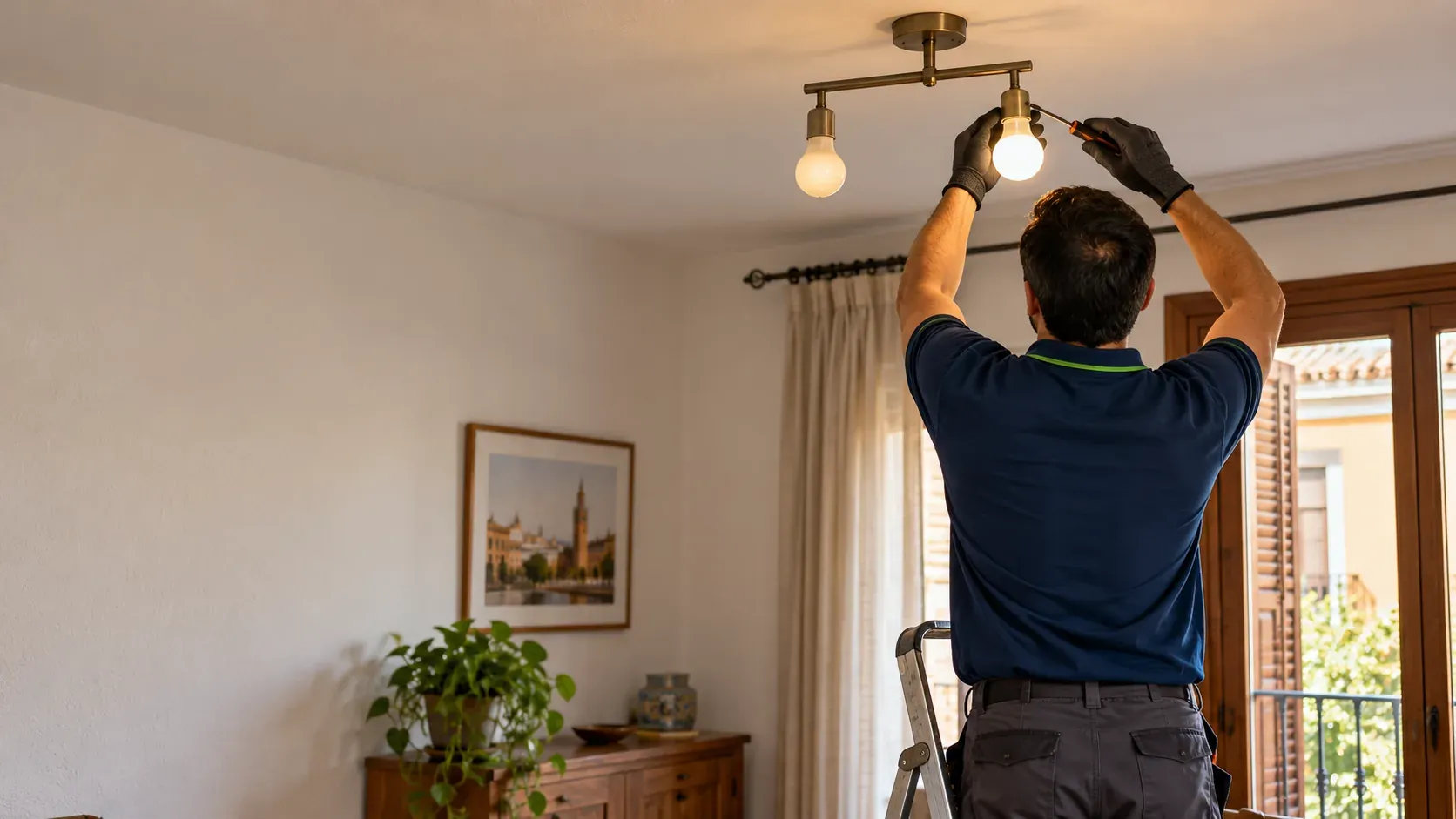
A bulb flickering for an instant when the washing machine starts can be normal. What is not normal is lights flickering often, the brightness going down and up for no reason, or the dips being noticeable all over the home. In those cases the installation is warning you that something is not connecting properly or that the voltage is not arriving as it should.
The key to the diagnosis is to notice which lights fail and when.
Causes by symptom
- A single lamp flickers. Almost always the bulb, the lamp holder or a loose terminal in the fitting or its switch. The simplest fault.
- An LED light flickers, whether off or on. An old, incompatible dimmer, a switch with an illuminated indicator or a faulty driver. If you are thinking of renewing your lighting, we advise you on an LED upgrade and on LED-compatible motion sensors and dimmers.
- The lights of one room or one circuit flicker. A loose contact in a junction box or at the terminal of that circuit’s breaker in the fuse board.
- Every light dims when the air conditioning, the oven or the water heater starts. A voltage drop caused by a cable with too small a cross-section or a loose connection in the riser cable.
- The light goes up and down all over the home and some appliances behave strangely. It may be a faulty neutral, which causes abnormal voltages. This is the most delicate situation.
- The whole neighbourhood flickers. The problem is in the distributor’s network.
Flickering is not tripping
Flickering lights are a different fault from the power cutting out. If a lever in the fuse board drops, read MCB keeps tripping for a circuit breaker, or RCD keeps tripping for the lever with the TEST button. If the whole home goes dark for a few seconds with nothing moving in the board, it is the smart meter cutting you off for exceeding your contracted power, explained in power limiter tripping. Flickering means the power is still there, but something is not connecting well.
Why you should not ignore it
A loose contact is a connection that is not tight. The current passes through that point with difficulty and generates heat. At first you only see a flicker; over the weeks the terminal darkens, the plastic deforms and it can end in a power cut or a burning smell. A neutral in poor condition can also expose appliances to surges that damage them.
The Spanish Low Voltage Electrotechnical Regulation, in ITC-BT-19, limits the voltage drop in indoor installations to 3 % on lighting circuits and 5 % for other uses. When the dips are visible to the naked eye, those limits are usually being exceeded or there is a faulty connection.
How we diagnose it
- We ask about the pattern: which lights, at what times and which appliances it coincides with.
- We measure the voltage at the fuse board and at the affected points, at rest and with the powerful appliances running.
- We check the connections of the fuse board, the main switch and the breakers, tightening or redoing damaged terminals.
- We open junction boxes and switches on the affected circuit looking for loose or burnt connections.
- We check the neutral and, if the problem is before the fuse board, the riser cable.
- We repair and measure again to confirm the voltage stays stable.
If the cause is in the service connection or the network, we tell you so you can report it to the distributor. If you lose power completely, see power cut at home, and if the fault is in the fuse board itself, see fuse board fault.
A typical case in Seville
In the older blocks of La Macarena, El Cerro or Nervión it is common for the living room lights to dim every time the air conditioning starts, especially on summer afternoons. When we measure, the voltage drops noticeably at start-up, and the cause is usually twofold: thin cables in an installation designed for very little power, and a terminal on the riser cable that has worked loose after years of heat. Tightening or redoing the connection stops the flicker, but if the cable is too small for today’s load, the lasting solution is to rewire the apartment.
Guide prices
| Job | Guide price (plus 21 % VAT) | Total with VAT |
|---|---|---|
| Diagnosis with voltage measurements | 70 to 100 euros | 84.70 to 121 euros |
| Repairing a loose contact in a switch or box | depending on the point | quoted beforehand |
| Replacing a dimmer or switch not compatible with LED | depending on the device | quoted beforehand |
You get the price of the repair before we do it. If the lights flicker and you also notice a burning smell or heat in a socket, do not wait: switch off the main switch and call our 24-hour emergency electrician. Other faults are on the emergency electrician page.
Frequently asked questions
Why do the lights in my home flicker?
The most frequent causes are a loose contact in a connection (bulb, lamp holder, switch, junction box or fuse board), an LED bulb that is not compatible with the dimmer, or a cable that causes a voltage drop when powerful appliances start. If every light flickers at once, the fuse board and the neutral need checking.
Is it dangerous when the lights dip and come back?
It can be. A loose contact generates heat at the connection and, over time, can burn the terminal or the box. If the changes are strong and affect the whole home, there may be a faulty neutral, which exposes your appliances to abnormal voltages and can damage them.
Why does an LED light flicker?
Usually for one of three reasons: an old dimmer that is not LED-compatible, a switch with an illuminated indicator that lets a small current through when it is off, or a poor-quality driver. It is fixed by changing the dimmer, the switch or the lamp itself for a compatible one.
Why do the lights dim when I switch on the air conditioning or the oven?
Because a powerful appliance starting up causes a voltage drop on the line. A slight, brief dip can be normal, but if it is very visible, the cable is too thin for the load or there is a loose connection in the riser cable or the fuse board. It needs measuring.
How much does the diagnosis cost in Seville, Spain?
Diagnosis with voltage measurements and a check of the connections costs 70 to 100 euros plus 21 % VAT (84.70 to 121 euros in total). If the problem is a switch or a loose terminal, the repair is usually done on the same visit. If a length of cable or a protection has to be replaced, you get the price first.
What if the lights flicker in the whole neighbourhood?
Then the cause is in the distribution network and not in your home. In Seville the distributor is e-distribución, and that is who you report voltage fluctuations to. If appliances are also damaged, keep the receipts and write down the date and time.
Related services
Power cut at home
No electricity in your apartment while the neighbours still have lights? Then the fault is in your part of the installation: the riser cable from the meter, the fuse board (consumer unit) or a joint. We find the cause, whether the whole home is dark or only half of it, and repair it.
Fuse board fault
A burnt fuse board (consumer unit, breaker panel in the US) with blackened terminals, circuit breakers that will not reset or a constant buzzing needs an electrician as soon as possible. In Seville, Spain we repair the fuse box of your home or business, replace the damaged parts and, if it has reached the end of its life, propose a new one.
Rewiring old apartments
Rewiring an apartment in Seville, Spain is the answer when the installation is more than 25 or 30 years old: fabric or dried-out cables, no earthing, a single RCD and a supply that cannot run the air conditioning and the induction hob at once. We renew cables, conduits, fuse board, earthing and fittings and hand you the boletín.
LED upgrade
An LED lighting upgrade in your home or building in Seville, Spain cuts lighting consumption by up to 80 % compared with halogen. We replace halogen, fluorescent and incandescent lamps with LED, change any transformers and drivers that need it and leave every room with the right light.
Motion sensors and dimmers
Motion sensor and dimmer installation in Seville, Spain, together with dusk-to-dawn switches and timers, means lights come on only when they are needed and at just the right level. You save in stairwells, entrance halls, garages, hallways and gardens, and gain comfort at home.
Need an electrician in Seville, Spain?
Call us or send a WhatsApp message with a photo of the job. You get a fixed quote before any work starts.