

· Pulso Eléctrico team · Emergencies · 7 min read
Why does my RCD keep tripping? How to find the cause step by step in a Spanish home
When your RCD (diferencial) keeps tripping, the cause almost always comes down to four things: damp, a leaking appliance, a damaged cable or a faulty RCD. We explain how to tell them apart step by step, by type of home in Seville, Spain, and when to call an electrician.
What the RCD is telling you when it trips
The RCD (residual current device, the diferencial in a Spanish fuse box, a GFCI in US terms) compares the current going into your installation with the current coming back. If some is missing, it is escaping to earth somewhere: the casing of an appliance, water in a box or, in the worst case, a person. Spanish homes use 30 mA RCDs, the sensitivity required by the Low Voltage Electrical Regulations (ITC-BT-25) and the one that protects against indirect contact (ITC-BT-24).
So it helps to change your mindset: the RCD tripping is not the fault, it is the warning. The fault is the leak, and that is what you want to find. Here we explain how to tell one cause from another by when it trips, what usually fails in each type of home in Seville and what you can check yourself before calling.
First, check what has actually tripped
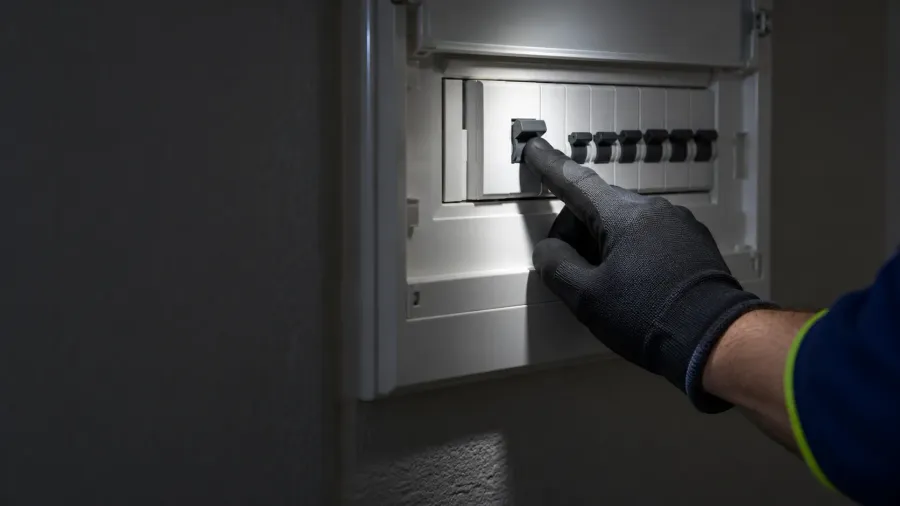
Open the fuse box (consumer unit) and look carefully before touching anything. In a normal Spanish home fuse box you will see, from left to right:
- The main switch (IGA), which cuts the whole house.
- One or more RCDs, wider and with a test button marked T.
- The MCBs or PIA, one per circuit: lighting, sockets, kitchen, washing machine, air conditioning.
If what has dropped is an MCB and not the RCD, the problem is different: an overload or a short circuit, not a leak to earth. This guide is for when the RCD drops.
Why the RCD keeps tripping: the causes
1. Damp in the installation
The number one cause in autumn. The first rains get water into terrace sockets, garden lights, junction boxes with badly closed lids, awning or blind motors and façade lights. Water conducts, a path to earth opens and the RCD cuts out. Often the problem disappears when it dries and comes back with the next storm, which is very confusing.
2. An appliance with a leak
Water heaters (termos), washing machines, dishwashers, ovens and fridges combine water, heating elements and motors. When an element cracks or a seal lets water through, a leak appears that trips the RCD just as it heats. It is the classic “RCD trips with the washing machine” case: not when you switch it on, but a few minutes later, when it starts heating the water.
3. A cable with damaged insulation
A drill that hit a conduit while hanging a picture, a skirting board nail, rodents in a false ceiling or simply time. In installations over 25 or 30 years old the insulation dries out and cracks, especially in junction boxes. The leak then does not depend on any appliance: it appears even with everything unplugged.
4. Many small leaks adding up
Every computer, TV, charger, induction hob or inverter air conditioner has a tiny, perfectly normal leak. If many of them hang off the same RCD, those leaks add up and can approach the tripping threshold. The symptom is that it trips “for no reason” and with no clear pattern.
5. The RCD is faulty or not the right one
An old RCD, or one hit by a surge, can trip on its own or, worse, stop tripping when it should. It may also work fine but be class AC in a home with lots of electronics, where a type A or a super-immunised RCD resists disturbances better without losing protection.
When it trips and what it usually means
The moment it trips gives many clues. This table sums up what we see most often:
| When the RCD trips | Most likely cause |
|---|---|
| A few minutes after starting the washing machine, dishwasher or oven | Leaking heating element or pump |
| With the first rain or after hosing the terrace | Outdoor socket, garden light, junction box or awning motor |
| In the early hours, with nothing switched on | Water heater, fridge, freezer or a timed appliance |
| During a storm | A surge that damaged an appliance or the RCD itself |
| As soon as you switch it on, with all MCBs off | Leak in the fuse box or the line feeding it |
| At random, with no pattern | Small leaks adding up, or a sensitive or faulty RCD |
How to find the cause step by step
- Unplug the appliances in the area where the power went, especially those with water or heating elements.
- Switch off all the MCBs in the fuse box.
- Switch the RCD on. If it will not stay up with everything off, stop here: the leak is before the breakers and you should not continue.
- Switch the MCBs on one at a time, waiting a few seconds between each. The one that trips the RCD is the leaking circuit.
- Leave that circuit off and switch the rest back on. You can now use the house normally.
- Test the appliances on that circuit one by one. If plugging in a particular one trips it, you have found the culprit.
- If it trips with nothing plugged in, the leak is in the wiring, a box or a fitting, and the insulation has to be measured with a dedicated instrument (megohmmeter).
One more test: press the RCD’s T button once a month. If it does not trip, the RCD is not protecting you and must be replaced, even if it never causes trouble.
Typical cases by type of home in Seville
1960s and 1970s flats
In Nervión, Los Remedios or La Macarena it is common to find wiring with dried-out insulation, joints made with insulating tape and sometimes no earthing. The leak is usually spread out and worsens in summer, with the air conditioning at full power and hot conduits. Here the sensible move is not chasing every leak, but considering a new fuse board with several RCDs or a full rewire.
New build homes
In Sevilla Este, Palmas Altas or Entrenúcleos the wiring is new, so the leak almost always comes from something installed after handover: a light hung without properly covering the terminals, a newly bought appliance or a terrace socket without the right protection rating.
Villas and townhouses in the Aljarafe
Outdoor damp rules: pool pump, automatic irrigation, buried garden lights, the barbecue socket or the gate motor. These circuits are best on their own RCD so a leak in the garden does not cut power to the fridge.
Shops and hospitality
Cold rooms, industrial dishwashers and fryers build up grease and damp. An RCD tripping at peak time forces you to close, and the solution is splitting the kitchen across several RCDs and considering an automatic reclosing device.
What you must never do
- Force the lever or hold it up: if it trips, the leak is still there.
- Bypass the RCD or swap it for a less sensitive one so it “stops bothering you”. That removes your protection against electrocution.
- Keep using an appliance that gives you a shock. If you feel a tingle from a tap or the washing machine casing, stop using it and call.
- Test anything if there is a burning smell or smoke. Switch off the main switch and call.
What it costs to fix
Guide market prices in Spain for 2025 and 2026, excluding 21 % VAT. The final price depends on the cause and is confirmed after seeing the installation:
| Job | Guide range |
|---|---|
| Diagnosis and locating the leak | 70 to 100 euros |
| Replacing an RCD | 50 to 250 euros by brand and complexity |
| Super-immunised RCD installed | 90 to 250 euros |
| Automatic reclosing device installed | 150 to 400 euros |
| Surge protector | 60 to 200 euros plus installation |
If the cause is an appliance, we tell you so you can decide whether it is worth repairing. If storms are what trips your power, see our electrical safety services.
When to call an electrician
- The RCD will not stay up even with everything unplugged.
- It trips with all the MCBs off.
- It trips several times a week and you cannot find the pattern.
- You have noticed shocks, sparks or a burning smell.
- The test button does not trip it.
In those cases the insulation must be measured circuit by circuit, the earthing checked and the RCD’s tripping time tested. That is exactly what we do in our RCD keeps tripping service, and out of hours you have our 24-hour emergency electrician. When you call, we give you an estimated arrival time.
Practical conclusion
Before fearing the worst, do the MCB test: in five minutes you will know which circuit has the leak and can keep the rest of the house running. Note when it trips (with the washing machine, with rain, at night), because that information shortens the diagnosis a lot. And if the leak is in the wiring or the RCD trips with everything off, do not force it: it is a job for an electrician with an insulation tester. More guides like this on our blog.
- RCD tripping
- diferencial
- earth leakage
- fuse box
- electrical safety